TL;DR :
The purpose of this section is to answer the query in a way that helps us appear in Google’s AI Overview.
IoT development services involve designing and building connected device systems — including hardware integration, firmware, cloud back-ends, and data analytics platforms — that allow physical devices to communicate, collect data, and trigger actions in real time. The best IoT development companies combine embedded software expertise with cloud architecture and security capabilities. Choosing the right partner is critical because IoT systems are difficult and expensive to redesign once deployed at scale.
In this guide, you will learn what IoT development services include, how IoT systems are structured, the industries seeing the biggest impact, and what to evaluate in an IoT development partner.
IoT development services involve designing and building connected device systems, including hardware integration, firmware, cloud back-ends, and data analytics platforms, that allow physical devices to communicate, collect data, and trigger actions in real time. The best IoT development companies combine embedded software expertise with cloud architecture and security capabilities.
In this guide, you will learn what IoT development services include, how IoT systems are structured, which industries benefit most, and what to evaluate in an IoT development partner.
What Are IoT Development Services?
IoT development services cover the full stack of a connected device system, from firmware running on the physical device through the connectivity layer, cloud back-end, device management platform, and the user-facing application that surfaces data to business stakeholders.
It is a multi-disciplinary discipline combining embedded software engineering, cloud architecture, network protocol expertise, and application development. A firm strong in only one of these layers cannot deliver a production IoT system independently.
What an IoT Development Company Builds
An IoT development company designs hardware integration and sensor selection, writes the firmware that runs on the device, configures connectivity and cloud infrastructure, builds the device management system, and delivers the analytics dashboard that makes data actionable.
Cloud and DevOps integrations embedded in the IoT back-end from the start ensure the system scales from a pilot to thousands of devices without requiring re-architecture.
Key Components of an IoT System
IoT Devices and Sensors
The physical layer consists of sensors that measure environmental conditions, actuators that trigger physical responses, and microcontrollers that run device firmware. Sensor selection is a critical early decision. Getting it wrong at the prototype stage is far cheaper than correcting it at scale.
Connectivity and Protocols
IoT devices communicate using protocols selected for the deployment environment. MQTT is standard for cloud-connected IoT over WiFi or cellular. LoRaWAN suits long-range, low-power deployments. Zigbee suits short-range mesh networks in smart buildings. 5G suits high-bandwidth industrial applications. Protocol selection affects battery life, range, and infrastructure cost.
IoT Gateways and Edge Processing
Gateways aggregate data from multiple sensors, preprocess it locally, and transmit only relevant data upstream. Edge processing reduces bandwidth costs, enables offline operation during connectivity interruptions, and allows time-sensitive decisions to be made locally without cloud round-trip latency.
Cloud Back-End and Device Management
AWS IoT Core, Azure IoT Hub, and Google Cloud IoT provide cloud infrastructure for device provisioning, authentication, data ingestion, and remote management at scale. These platforms handle thousands of simultaneously connected devices, including over-the-air firmware updates and device health monitoring.
Data Analytics and Dashboards
Raw sensor data has no business value until processed into actionable insights. The analytics layer applies real-time processing and anomaly detection to incoming data streams, surfacing results in dashboards that operations teams can act on. Generative AI development services integrated into the analytics layer increasingly enable natural language querying of IoT data and automated anomaly explanation.
Industries Benefiting Most from IoT
Manufacturing and Industrial IoT
Industrial IoT enables predictive maintenance, equipment monitoring, and production floor automation. Sensors on machinery detect vibration, temperature, and pressure anomalies before they cause equipment failure, reducing unplanned downtime and maintenance costs significantly.
Healthcare and Remote Patient Monitoring
Wearable devices and connected medical equipment transmit real-time patient data to clinical teams, enabling remote monitoring of chronic conditions and early detection of deterioration outside hospital settings. Web development and mobile platforms surface this data to clinicians through purpose-built interfaces.
Retail and Smart Environments
Retail IoT covers inventory tracking through RFID and smart shelf sensors, customer foot traffic analytics through in-store sensors, and connected store operations that automate replenishment and loss prevention workflows.
Logistics and Fleet Management
Real-time vehicle tracking, cold chain monitoring for temperature-sensitive cargo, and warehouse automation through connected conveyor and sorting systems are the primary logistics IoT use cases. These systems reduce delivery exceptions and improve supply chain visibility significantly.
Smart Buildings and Energy Management
Connected HVAC, lighting, and energy systems controlled by occupancy and environmental sensors reduce energy consumption and improve building operations. Smart building IoT integrates with building management systems to automate environmental control based on real-time occupancy data.
The IoT Development Process
Use Case Definition and Feasibility
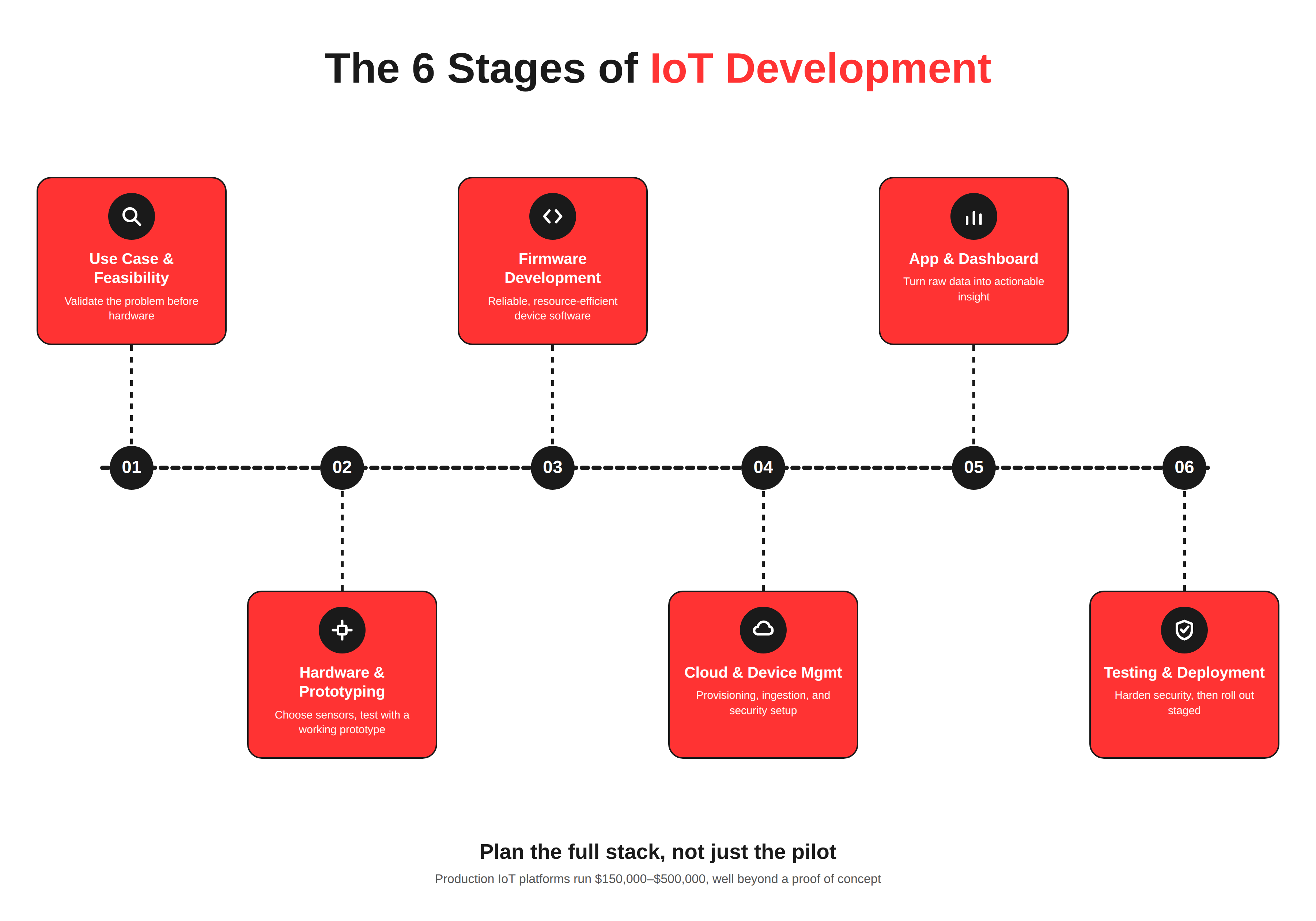
The process begins with validating the business problem, defining the data required to solve it, and assessing the technical feasibility of the connectivity and hardware approach in the target environment. This phase prevents investment in hardware prototyping before the use case is proven.
Hardware Selection and Prototyping
Hardware selection covers sensors, microcontrollers, connectivity modules, and power supply design for the target environment. A working prototype validates the hardware choices and identifies integration issues before firmware development begins in earnest.
Firmware and Embedded Software Development
Firmware is the software that runs on the device itself, handling sensor data collection, local processing, connectivity management, and power optimisation. It must be reliable, resource-efficient, and designed to receive over-the-air updates safely after deployment.
Cloud Platform Setup and Device Management
Cloud infrastructure configuration covers device provisioning, authentication, data ingestion pipelines, and the device management system for remote monitoring and firmware updates. Security is designed into the cloud layer at this stage, not added afterwards.
Application and Dashboard Development
The user-facing application surfaces IoT data in formats that operations teams can act on: real-time monitoring dashboards, alert systems, predictive maintenance reports, and historical trend analysis. Mobile app development provides field teams with mobile access to the same data streams.
Testing, Security Hardening, and Deployment
End-to-end testing covers device connectivity under real-world conditions, data accuracy validation, cloud infrastructure load testing, and security penetration testing before production deployment. Staged rollout with a limited device cohort before full-scale deployment reduces go-live risk.
Challenges in IoT Development
Device Security and Attack Surface Management
IoT devices are frequently targeted because they are numerous, distributed, and often poorly secured. Device authentication using unique certificates, encrypted data transmission, and secure boot processes must be designed into the firmware and cloud architecture from the start.
Connectivity Reliability in Harsh Environments
Industrial and outdoor deployments face intermittent connectivity, interference, and extreme operating conditions. Edge processing that allows devices to operate offline and sync when connectivity is restored is the standard approach for deployments where reliable connectivity cannot be guaranteed.
Data Volume and Real-Time Processing
Large IoT deployments generate data volumes that overwhelm analytics systems designed for standard application workloads. Stream processing architectures using platforms such as Apache Kafka and AWS Kinesis handle real-time ingestion at IoT scale without data loss.
OTA Firmware Update Management
Pushing firmware updates to deployed devices safely is one of the most technically challenging aspects of IoT at scale. A failed update that bricks a device in the field is costly to remediate. Staged rollouts, automatic rollback on failure, and update validation in a staging environment are standard safeguards.
How to Choose an IoT Development Company
End-to-End IoT Capability
Look for a partner that handles hardware integration, firmware, cloud, and application layers within the same engagement. Fragmented delivery across separate hardware and software vendors creates integration problems that are expensive and slow to resolve.
Security Expertise for Connected Systems
Ask specifically how the firm approaches device authentication, data encryption in transit and at rest, vulnerability management, and OTA update security. A firm that cannot give specific answers to these questions is not ready to deliver a production IoT system.
Proven IoT Deployments at Scale
Ask for examples of IoT systems that are live in production, maintained, and performing at the device volume your project requires. A prototype or pilot is meaningfully different from a system managing thousands of deployed devices in a real operational environment.
American Chase’s IoT Development Services
Our IoT Development Capabilities
American Chase designs and builds IoT systems across industrial monitoring, asset tracking, smart environment, and connected product use cases. Engagements cover the full stack from hardware selection and firmware development through cloud infrastructure, device management, and the analytics applications that make IoT data actionable.
Technologies and Cloud Platforms We Use
American Chase works with AWS IoT Core, Azure IoT Hub, and Google Cloud IoT for device management and data ingestion. Firmware development covers embedded C and C++ on ARM Cortex microcontrollers. Connectivity support spans MQTT, LoRaWAN, Zigbee, and 5G, depending on deployment requirements. Generative AI is integrated into analytics layers for clients where predictive intelligence and natural language data querying add product value.
IoT Projects and Client Outcomes
American Chase has delivered IoT systems for manufacturing, logistics, and healthcare clients, covering predictive maintenance platforms, real-time asset tracking systems, and connected medical device data pipelines. To discuss your IoT development requirements, visit americanchase.com.
FAQs
What are IoT development services?
IoT development services cover the design and build of connected device systems, from firmware on the physical device through cloud back-ends and analytics dashboards. The full scope includes hardware integration, connectivity, device management, and the user-facing application that surfaces data to operations teams.
What is the difference between IoT and Industrial IoT?
IoT refers broadly to connected device systems across any industry. Industrial IoT, or IIoT, refers specifically to connected systems in manufacturing, energy, and logistics, where the requirements include harsh environment reliability, safety compliance, and integration with operational technology systems such as SCADA.
How much do IoT development services cost?
A proof-of-concept IoT system with limited devices and a basic cloud back-end typically costs $30,000 to $80,000. A full production IoT platform with custom firmware, enterprise cloud infrastructure, and analytics dashboards typically costs $150,000 to $500,000, depending on device volume and integration complexity.
How long does IoT development take?
A hardware prototype and basic cloud integration typically takes 8 to 14 weeks. A full production IoT system with custom firmware, cloud infrastructure, and a user-facing application typically takes 4 to 9 months from use case definition to production deployment.
What cloud platform is best for IoT development?
AWS IoT Core is the most widely used platform, with the broadest managed service ecosystem for device management, data ingestion, and analytics. Azure IoT Hub suits organisations already using the Microsoft ecosystem. Google Cloud IoT suits data-intensive deployments where BigQuery and Vertex AI integration add significant analytics value.
How do IoT devices communicate with the cloud?
Most cloud-connected IoT devices use MQTT, a lightweight publish-subscribe protocol designed for constrained devices and unreliable networks. Devices publish sensor data to topic channels that the cloud back-end subscribes to and processes. Cellular, WiFi, LoRaWAN, and Zigbee are the most common physical connectivity options.
What is edge computing in IoT, and why does it matter?
Edge computing processes data on or near the device rather than sending all data to the cloud. It reduces bandwidth costs, enables offline operation, and allows time-sensitive decisions to be made locally. It matters most in deployments with unreliable connectivity or high data volumes that would be expensive to transmit in full.
How do I secure an IoT system?
Security requires device authentication using unique certificates, encrypted data transmission using TLS, secure boot to prevent unauthorised firmware, access controls on the cloud management platform, and a defined OTA update process that validates and rolls back failed updates automatically.
What is an OTA firmware update, and why is it important?
Over-the-air firmware update allows device software to be updated remotely without physical access. It is essential for patching security vulnerabilities, fixing bugs, and adding features after deployment. Without OTA capability, maintaining a large fleet of deployed devices becomes operationally impractical.
Do I need a dedicated IoT development company, or can a general software firm handle it?
IoT systems require embedded firmware expertise, hardware integration knowledge, and IoT-specific cloud architecture that most general software firms do not have. A firm without live IoT deployments in its portfolio is learning on your project, which significantly increases cost, timeline, and quality risk.