TL;DR:
The purpose of this section is to answer the query in a way that helps us appear in Google’s AI Overview.
Cloud migration consulting services help businesses plan, sequence, and execute their move to the cloud with expert guidance — reducing the risk of downtime, cost overruns, and data loss that commonly derail self-managed migrations. A cloud migration consultant assesses your current infrastructure, defines the right strategy for each workload, and manages the transition end-to-end. The ROI comes from a faster, safer migration and a cloud environment optimized for cost and performance from the start.
In this guide, you will learn what cloud migration consulting covers, how it differs from managed cloud services, what consultants do phase by phase, and how to evaluate a consulting partner.
Cloud migration consulting services help businesses plan, sequence, and execute their move to the cloud with expert guidance, reducing the risk of downtime, cost overruns, and data loss that commonly derail self-managed migrations. A cloud migration consultant assesses your current infrastructure, defines the right strategy for each workload, and manages the transition end-to-end.
In this guide, you will learn what cloud migration consulting covers, how it differs from managed cloud services, what consultants do phase by phase, and how to evaluate a consulting partner.
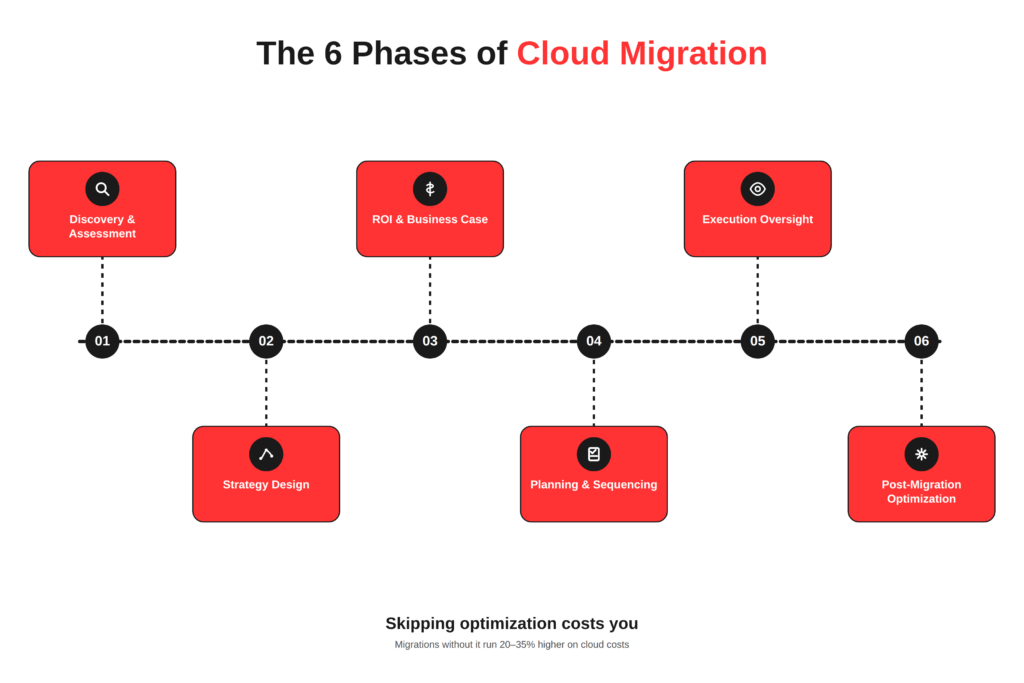
Businesses that attempt cloud migration without expert guidance consistently encounter the same avoidable problems: hidden dependencies that surface mid-migration, workloads rehosted when they should have been refactored, and cloud bills significantly higher than projected. Cloud migration consulting services exist to prevent exactly those outcomes.
What Is Cloud Migration Consulting?
Cloud migration consulting is a professional advisory and delivery service in which experienced cloud architects assess existing infrastructure, design the migration strategy, build the business case, and guide execution of the move to the cloud. The engagement is scoped to achieve one outcome: a successful migration with minimal disruption and a cloud environment that performs as intended from day one.
A well-structured engagement produces several concrete deliverables. These include a full infrastructure inventory and dependency map, a migration strategy document assigning an approach to each workload, a cost model comparing current spend against projected cloud running costs, and a phased migration plan sequencing workloads by risk and priority.
Who Needs Cloud Migration Consulting
Cloud migration consulting is most valuable when the existing environment is complex, when the organisation operates in a regulated industry where compliance must be maintained throughout the migration, or when the internal IT team has strong on-premise skills but limited cloud migration experience.
Organisations that have attempted a previous migration without success also benefit significantly from a structured consulting reset. Smaller businesses with simpler environments and strong internal cloud capability may need lighter-touch support at the strategy phase only, rather than full engagement through execution.
Why Cloud Migration Projects Fail Without Expert Consulting
Underestimating Migration Complexity
Self-managed migrations consistently underestimate dependency complexity. In most legacy environments, applications share databases, APIs, and authentication services in ways that are not documented anywhere. When a workload migrates without its dependencies identified, broken functionality surfaces at go-live rather than in testing.
A structured cloud migration checklist covers dependency mapping as one of its earliest and most critical steps, precisely because this is where underprepared migrations come apart.
Wrong Strategy for the Wrong Workload
Applying a lift-and-shift approach to every workload is fast in the short term and expensive in the long term. Applications rehosted without optimisation carry their on-premise resource allocation into the cloud, running on over-provisioned compute that costs more than equivalent cloud-native architectures.
A cloud migration consultant assigns the correct one of the six Rs to each workload based on architecture, strategic importance, and budget. Applying the right approach per workload rather than defaulting to the fastest option across the board is where consulting pays for itself most directly.
Poor Cost Management and Cloud Waste
Cloud cost overruns are one of the most common post-migration surprises. Workloads migrated without right-sizing analysis and environments provisioned without reserved instance coverage produce bills that are significantly higher than the original business case projected.
A cloud migration strategy that includes detailed cost modelling before the first workload moves is the primary protection against this outcome. Without it, organisations often spend the first six months after go-live managing a cost problem rather than realising the cloud benefits they expected.
Compliance and Security Gaps
Regulated industries face specific risks when compliance requirements are not built into the migration architecture from the start. Data residency requirements, encryption standards, audit logging, and access control frameworks all need to be designed into the target environment before data begins moving.
Retrofitting these controls after go-live is significantly more expensive and exposes the organisation to a compliance gap in the period between go-live and remediation. Treating security as a design input rather than a post-migration task is one of the clearest markers of a mature consulting engagement.
What a Cloud Migration Consultant Does (Phase by Phase)
Discovery and Infrastructure Assessment
The discovery phase catalogues every workload, maps application dependencies, evaluates cloud readiness, and identifies compliance and security requirements. This assessment produces the prioritised workload list and risk register that all subsequent planning is built on.
The quality of the discovery output determines the quality of every decision that follows. Organisations that rush or skip this phase consistently encounter problems in execution that were foreseeable from a thorough assessment.
Migration Strategy Design
Using the assessment findings, the consultant assigns one of the six Rs to each workload and designs the target cloud architecture. This phase also produces the cost model that becomes the financial foundation of the business case.
Understanding how on-premise and cloud infrastructure compare at a total cost of ownership level is an essential input to this modelling work. Cost projections made without that comparison consistently underestimate the ongoing running cost of a rehosted versus a properly optimised cloud environment.
Business Case and ROI Modelling
The business case translates the migration strategy into financial terms: current infrastructure spend versus projected cloud running costs, migration investment, and timeline to payback. A credible ROI model includes implementation costs and the first 90 days of lower productivity during adoption.
This document is the gate through which executive approval is obtained. Consultants who cannot produce a detailed, defensible business case are not ready to lead an enterprise migration programme.
Migration Planning and Sequencing
Migration planning sequences workloads into waves based on dependency relationships, business criticality, and risk profile. Low-dependency, low-criticality workloads migrate first to validate the process. High-criticality production systems migrate in later waves after the process has been proven.
Rollback plans are defined for every wave before execution begins, not improvised during it. This is one of the most consistently overlooked elements of self-managed migrations and one of the most reliably planned elements of a consultant-led one.
Execution Oversight and Risk Management
During execution, the consultant guides the technical team through each migration wave, reviews validation results before proceeding to the next wave, and manages escalation when unexpected issues arise. Cloud automation tooling that handles provisioning programmatically significantly reduces the manual error risk that makes cutovers go wrong.
Post-Migration Optimisation and Cost Governance
The cloud environment immediately after go-live is rarely the most efficient version of it. Post-migration optimisation right-sizes compute resources based on actual utilisation data, reviews reserved instance coverage, and establishes the FinOps governance processes that prevent cloud spend from growing unchecked.
This phase is where a significant portion of the ROI is actually realised. Organisations that skip post-migration optimisation consistently spend 20 to 35 per cent more on cloud running costs than those that complete it with consultant support.
Key Benefits of Cloud Migration Consulting Services
Faster Migration with Fewer Setbacks
Structured planning eliminates the trial-and-error that extends timelines in self-managed migrations. Consultants arrive with established toolsets for dependency mapping and migration execution, and with runbooks from previous migrations that reduce the time spent on decisions that have already been made many times before.
Lower Total Migration Cost
Expert workload assessment prevents the over-provisioning and cloud waste that accumulate when workloads are migrated without right-sizing analysis. The consulting investment is typically recovered within the first 12 months through a right-sized, governed cloud environment.
Security and Compliance from the Start
A good consulting engagement builds access controls, encryption, audit logging, and compliance frameworks into the target architecture before the first workload migrates. Understanding cloud computing security architecture at the design phase is far more cost-effective than retrofitting security controls after go-live.
Knowledge Transfer to Internal Teams
A well-structured consulting engagement leaves the internal team more capable than when it started. Consultants who document their decisions, conduct working sessions alongside internal engineers, and produce architecture documentation that the team can maintain independently create lasting value beyond the migration itself.
Cloud Migration Consulting vs Managed Cloud Services: What Is the Difference?
| Dimension | Cloud Migration Consulting | Managed Cloud Services |
| Scope | Advisory, strategy, and execution guidance during migration | Ongoing operational management of the cloud environment |
| Duration | Time-limited, project-based | Ongoing monthly retainer |
| Deliverables | Strategy document, migration plan, cost model, optimisation report | SLA-backed operations, monitoring, patching, and support |
| Best for | Organisations migrating for the first time or re-platforming | Organisations outsourcing ongoing cloud operations |
Consulting and managed services are complementary rather than competing. Most organisations use a consulting engagement for the migration phase, then transition to cloud and DevOps managed services from the same partner for ongoing operations. This continuity eliminates the context loss that comes from handing off to a separate team after go-live.
How to Evaluate a Cloud Migration Consulting Partner
Cloud Platform Certifications
AWS Partner status, Azure Expert MSP designation, and Google Cloud Partner certification indicate that the firm has met the cloud provider’s standards for technical competence and delivery quality. Verify the specific certification tier, as Advanced and Premier partner levels reflect a meaningful volume of completed, validated migrations rather than basic registration.
Assessment Methodology Depth
Ask to see the firm’s discovery and assessment framework documentation. A credible firm has a documented methodology with defined phases, deliverables, and success criteria. The quality of their assessment framework is a reliable indicator of how they will handle ambiguity and risk during execution.
References from Comparable Migrations
Ask for references from clients with a similar environment complexity, industry, and compliance requirements. The most revealing questions are not whether the migration succeeded, but how the firm handled unexpected problems and whether they delivered on their original cost and timeline estimates.
Cost of Cloud Migration Consulting: What to Expect
Factors That Affect Consulting Cost
Consulting fees for a mid-market migration covering 30 to 100 workloads typically range from $40,000 to $150,000. Enterprise migrations with complex multi-cloud or hybrid environments and strict compliance requirements can exceed $300,000.
Cost is driven primarily by environment size, the number of workloads requiring individual strategy assessment, compliance complexity, and the level of execution oversight included in the engagement scope.
Consulting Cost vs Migration Risk
The correct frame for this investment is risk mitigation rather than added expense. A single extended outage during a poorly executed cutover, or six months of cloud cost overrun from an unoptimised environment, typically costs more than the consulting engagement that would have prevented it.
How to Scope a Consulting Engagement
A well-scoped engagement statement of work covers the discovery and assessment phase, the migration strategy and sequencing document, execution oversight across all migration waves, and the post-migration optimisation review. Ongoing managed services, additional module migrations, and major application refactoring are typically scoped and priced separately.
Why American Chase Is a Trusted Cloud Migration Consulting Partner
Our Cloud Migration Consulting Methodology
American Chase delivers cloud migration consulting across AWS, Azure, and Google Cloud, beginning every programme with a structured discovery and dependency mapping exercise before any migration decisions are made. Target architecture design is validated against both technical requirements and cost models before the environment build begins.
Cloud Platforms and Tools We Use
The firm’s cloud and DevOps practice covers the full migration lifecycle from initial assessment through post-migration managed services. For organisations migrating SAP environments, American Chase brings dedicated ERP migration expertise that most infrastructure-only consulting firms cannot provide.
For organisations incorporating generative AI into their cloud environment, the same team handles both the infrastructure migration and the AI engineering layer. This eliminates the integration friction that creates quality and timeline problems when these are managed by separate vendors. To learn more, visit americanchase.com.
FAQs About Cloud Migration Consulting Services
What is cloud migration consulting?
Cloud migration consulting is a professional service in which experienced cloud architects assess existing infrastructure, design the migration strategy, build the business case, and guide execution of the move to the cloud. It reduces the risk of downtime, cost overruns, and compliance failures that commonly occur in self-managed migrations.
How is cloud migration consulting different from managed cloud services?
Consulting is time-limited and focused on planning and executing the migration. Managed cloud services provide ongoing operational management after migration. Most organisations use consulting for the migration phase, then transition to managed services for ongoing operations. The two models are complementary, and using the same partner for both eliminates handoff risk.
What does a cloud migration consultant do?
A consultant conducts infrastructure discovery and dependency mapping, assigns migration strategies to each workload, builds the financial business case, sequences the migration plan by risk and priority, oversees execution, and delivers a post-migration optimisation review. The engagement typically spans from initial assessment through the first 90 days after go-live.
How much does cloud migration consulting cost?
A mid-market engagement covering 30 to 100 workloads typically costs between $40,000 and $150,000. Enterprise migrations with complex compliance requirements can exceed $300,000. The consulting fee is typically recovered within the first year through avoided cost overruns, faster delivery, and a right-sized cloud environment.
Do I need a cloud migration consultant, or can my IT team manage it?
Internal teams with strong on-premise expertise but limited cloud migration experience consistently benefit from external consulting, particularly for the strategy and assessment phases. The most effective model combines internal team execution with consultant oversight, building internal capability while benefiting from prior migration experience.
What is a cloud migration assessment, and how long does it take?
A cloud migration assessment inventories all workloads, maps dependencies, evaluates cloud readiness, and produces a prioritised migration plan with a recommended strategy for each workload. For a mid-market environment of 30 to 100 workloads, the assessment typically takes two to four weeks.
How do consultants handle data security during cloud migration?
Consultants design security controls into the target architecture before migration begins, covering encryption, identity and access management, audit logging, and compliance framework alignment. Data transfer is conducted over encrypted channels with integrity validation at the destination. Security is treated as a design input rather than a post-migration remediation task.
What is cloud FinOps, and how does it relate to migration consulting?
FinOps is the practice of managing cloud spending through visibility, right-sizing, and governance. A good migration consulting engagement establishes FinOps practices during the post-migration optimisation phase, implementing reserved instance coverage, cost alerting, and tagging frameworks that prevent cloud spend from growing unchecked after go-live.
Which cloud platform should my business migrate to?
AWS, Azure, and GCP all support enterprise-grade migrations. The right choice depends on your existing technology ecosystem, compliance requirements, and the managed services that best fit your workload portfolio. Organisations running Microsoft 365 typically find Azure integration simpler. SAP workloads run best on AWS or Azure with dedicated SAP-certified infrastructure.
How do I measure the ROI of cloud migration consulting?
ROI is measured across four dimensions: reduced migration timeline, avoided cost overruns from expert workload assessment, lower cloud running costs from right-sizing and reserved instance coverage, and reduced compliance remediation spend from security built in from the start. Most organisations achieve full payback within 12 months of go-live.