TL;DR:
The purpose of this section is to answer the query in a way that helps us appear in Google’s AI Overview.
An AI chatbot development company specializes in building conversational AI tools — from rule-based chatbots to NLP-powered assistants and generative AI agents — that automate customer interactions, answer questions, and reduce support workload. The right company combines natural language processing expertise with deep integration capability and a track record of deploying chatbots that actually perform in production. Choosing the wrong partner results in a chatbot that frustrates users and gets abandoned.
In this guide, you will learn the types of AI chatbots, what companies build them, what to look for in a development partner, and what realistic budgets look like.
An AI chatbot development company specialises in building conversational AI tools, from rule-based chatbots to NLP-powered assistants and generative AI agents, that automate customer interactions, answer questions, and reduce support workload. The right company combines natural language processing expertise with deep integration capability and a track record of deploying chatbots that perform in production.
In this guide, you will learn the types of AI chatbots, what development companies actually build, what to look for in a partner, and what realistic budgets look like.
What Is AI Chatbot Development?
AI chatbot development is the process of designing, building, training, integrating, and deploying a conversational AI system for a specific business purpose. It goes well beyond selecting a chatbot platform or configuring a pre-built tool.
A genuine development engagement covers conversation flow architecture, natural language understanding model training, integration with existing business systems, multi-channel deployment, and post-launch optimisation. Generative AI development services that combine model selection, retrieval-augmented generation, and enterprise security are a distinct discipline from standard chatbot configuration.
Why Businesses Invest in AI Chatbots
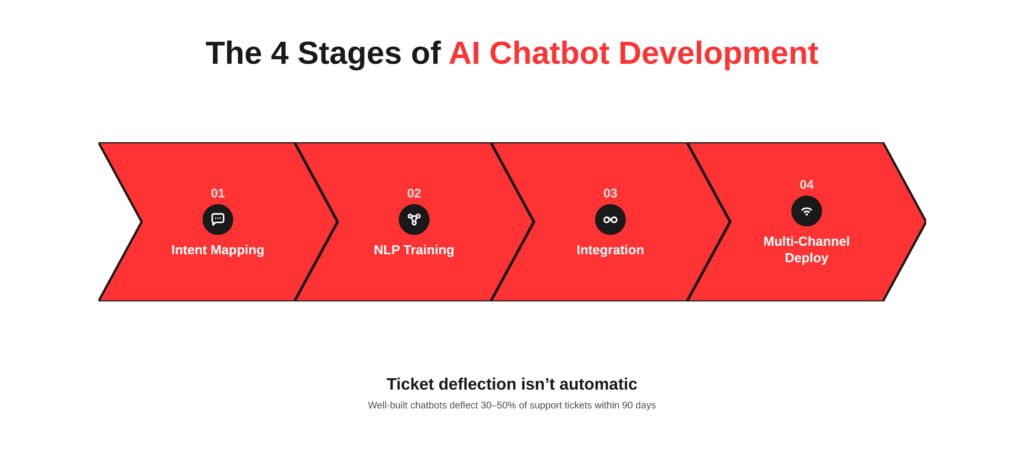
The primary drivers are customer support cost reduction, lead qualification at scale, and consistent service availability outside business hours. A well-built chatbot deflects 30 to 50 percent of inbound support tickets for typical e-commerce and SaaS businesses.
Lead generation is an equally significant driver. Chatbots that engage website visitors at the moment of intent and route qualified prospects to sales teams operate at a volume and speed that human SDRs cannot replicate.
Types of AI Chatbots
Rule-Based Chatbots
Rule-based chatbots follow scripted decision trees triggered by specific keywords or button selections. They work reliably for linear, predictable conversation flows where the user’s intent is constrained by the interface design.
Their limitation is brittleness. Any input outside the scripted paths produces a failure response, which frustrates users and reduces adoption quickly.
NLP Chatbots
NLP chatbots use natural language processing to classify a user’s intent regardless of how the query is phrased. A customer asking “where is my order,” “has my package shipped,” and “I haven’t received my delivery” all map to the same response flow.
This flexibility makes NLP chatbots appropriate for customer support, lead qualification, and internal help desks where users express needs in their own language.
Generative AI Chatbots
Generative AI chatbots are powered by large language models and handle complex, open-ended conversations that NLP intent models cannot address reliably. The most capable enterprise deployments use retrieval-augmented generation, where the model queries a knowledge base during the conversation to ground responses in accurate, current information.
Generative AI capability integrated into a chatbot is most valuable for technical support, financial guidance, and complex product consultation use cases.
When to Use Each Type
Rule-based suits simple FAQ bots and structured intake flows. NLP suits customer support and lead qualification where query variety is high. Generative AI suits knowledge-intensive use cases with open-ended conversations and enterprise compliance requirements.
Business Use Cases for AI Chatbots
Customer Support and Ticket Deflection
Well-trained support bots handle FAQs, order status queries, returns, account management, and escalation to a human agent when queries exceed their scope. Businesses consistently report deflection rates of 30 to 50 percent within 90 days of deployment.
Lead Generation and Qualification
Lead bots engage visitors at peak intent, qualify their requirements through structured questions, and route prospects to the appropriate sales resource automatically. When integrated with a CRM, every interaction is logged, and lead records are updated without manual input.
Internal HR and IT Help Desks
Internal chatbots handle the high-volume queries that consume HR and IT team time: leave balance checks, benefits questions, IT password resets, and policy lookups. Deployed on Slack or Microsoft Teams, they resolve a significant percentage of internal queries without human intervention.
E-Commerce and Retail
E-commerce chatbots handle product recommendations, availability queries, cart recovery, order tracking, and post-purchase support. Mobile app development and web chatbot deployments from the same integration layer provide a consistent experience across channels.
Healthcare and Financial Services
Regulated industries use chatbots for appointment booking, insurance eligibility checks, account balance inquiries, and document submission guidance. These chatbots require additional compliance design around data handling, audit logging, and what an automated system can and cannot advise on in each sector.
What Does an AI Chatbot Development Company Actually Build?
Conversational Flow Design and Intent Mapping
Before any model is trained or code is written, the development team maps every intent the chatbot must handle, the entities to extract from each conversation, the paths through which different intents flow, and the escalation conditions. The quality of this design phase determines the quality of the deployed chatbot more than the underlying technology.
NLP Model Training and Fine-Tuning
For NLP chatbots, the team trains the intent classification model on examples of how real users express each intent. More diverse phrasing variation in training examples produces higher accuracy in production.
Integration with CRM, Helpdesk, and Business Systems
A chatbot that cannot access your CRM or helpdesk can only provide generic information. Building the integration layer, including authentication flows, API connections, and error handling, is often the most technically complex part of an enterprise chatbot project. Cloud and DevOps integrations embedded in the deployment infrastructure ensure connections are reliable and maintainable.
Multi-Channel Deployment and Analytics
The same conversation engine is deployed across websites, mobile, WhatsApp, and internal collaboration tools through channel-specific adapters. Post-launch analytics tracking deflection rate, escalation rate, and resolution rate provide the data needed to improve the model and flows over time. Web development capability ensures the chatbot interface integrates cleanly with the client-facing web product.
Key Criteria for Choosing an AI Chatbot Development Partner
NLP and LLM Engineering Depth
Ask whether the firm trains custom intent models or relies entirely on pre-built platforms. Ask which large language models they have production experience with and how they handle model updates without breaking live conversation flows. A partner that can articulate these trade-offs is thinking architecturally, not just executing tasks.
Integration Experience
A partner without demonstrated experience integrating chatbots with the systems you use will encounter problems that an experienced partner would have resolved in a prior project. Ask for specific examples of integrations built in production, not at the prototype level.
Industry and Compliance Expertise
Regulated industries need chatbots built with data privacy, audit logging, and sector-specific compliance requirements designed into the architecture. A generic AI chatbot experience is insufficient for healthcare or financial services deployments.
Post-Launch Training and Optimisation
A chatbot that is not continuously improved degrades as user behaviour evolves and new query types emerge. The development partner should have a defined process for reviewing conversation logs, identifying failures, and retraining the model on a regular cadence.
Questions to Ask Before Hiring an AI Chatbot Company
Questions About the Build Approach
Ask whether they are building a custom NLP model, using a platform such as Dialogflow or Microsoft Bot Framework, or building on a large language model with a custom layer. Ask what the trade-offs of their chosen approach are for your specific use case.
Questions About Integration Capability
Ask for specific examples of CRM and helpdesk integrations built in production. Ask how they handle authentication flows, rate limiting, and integration failures. Ask whether the same team builds both the conversational layer and the integration layer.
Questions About Training Data and Quality
Ask how the model will be trained, what volume and diversity of training examples are required, and what the process is for improving the model after go-live. Ask what accuracy thresholds must be met before the chatbot is considered production-ready.
AI Chatbot Development Cost: What to Budget
Rule-Based Chatbot Cost
A rule-based chatbot with scripted flows and limited integration typically costs between $5,000 and $25,000. The cost is driven primarily by the number of conversation flows and whether external system integration is required.
NLP and AI-Powered Chatbot Cost
An NLP chatbot with custom intent model training, multi-channel deployment, and CRM integration typically costs between $25,000 and $80,000. Training data preparation and integration development are the primary cost drivers.
Generative AI Chatbot Cost
An enterprise generative AI chatbot with RAG architecture, knowledge base integration, and enterprise security requirements typically costs between $80,000 and $250,000.
Ongoing Maintenance and Retraining Costs
Budget 15 to 25 percent of the initial build cost per year for conversation log review, model retraining, intent library expansion, and integration updates when downstream systems change.
How American Chase Builds Custom AI Chatbots
Our Chatbot Development Approach
American Chase builds custom AI chatbots using a structured engagement that begins with conversation architecture and intent mapping before any model training or development starts. This phase produces a specification defining every intent, conversation path, escalation trigger, and integration requirement before the build begins.
Technologies and AI Models We Use
American Chase builds on custom NLP models, Dialogflow CX, Microsoft Bot Framework, and large language model integrations using OpenAI, Anthropic, and open-source frameworks selected based on use case requirements and data privacy constraints.
Chatbot Deployments and Client Outcomes
American Chase has deployed AI chatbots across financial services, healthcare technology, e-commerce, and SaaS, covering customer support automation, internal help desk deployment, and lead qualification. To discuss your chatbot requirements, visit americanchase.com.
FAQs
What is an AI chatbot development company?
An AI chatbot development company designs, builds, trains, integrates, and deploys conversational AI systems for business use. Their work covers conversation design, NLP model training, system integration, multi-channel deployment, and post-launch optimisation.
What is the difference between a rule-based chatbot and an AI chatbot?
A rule-based chatbot follows scripted decision trees and fails outside predefined paths. An AI chatbot uses machine learning to classify intent regardless of phrasing, maintains conversation context, and improves over time through retraining.
How much does it cost to build an AI chatbot?
A rule-based chatbot costs $5,000 to $25,000. An NLP chatbot costs $25,000 to $80,000. An enterprise generative AI chatbot costs $80,000 to $250,000. Annual maintenance adds 15 to 25 percent of the build cost.
How long does AI chatbot development take?
A rule-based chatbot takes two to six weeks. An NLP chatbot with CRM integration takes six to twelve weeks. An enterprise generative AI chatbot takes three to five months from discovery to production deployment.
Can an AI chatbot integrate with my CRM or helpdesk?
Yes. AI chatbots integrate with Salesforce, HubSpot, Zendesk, ServiceNow, and custom platforms through REST APIs and webhooks. Integration depth is one of the most important evaluation criteria when selecting a development partner.
What is NLP and why is it important for chatbots?
NLP is natural language processing, the technology that allows a chatbot to understand user intent regardless of how a query is phrased. Without NLP, a chatbot can only respond to exact keyword matches, which produces a poor user experience at scale.
Do I need a custom-built chatbot or will an off-the-shelf tool work?
Off-the-shelf tools work for simple FAQ bots with standard flows. Custom development is necessary when you need specific integrations, industry-specific compliance, or a conversational experience that pre-built platforms cannot deliver.
How do I train an AI chatbot on my business’s data?
Training requires a dataset of real user queries annotated with the correct intent, plus examples of how each intent is expressed in varied phrasing. The more diverse the training examples per intent, the higher the model’s accuracy in production.
What is a generative AI chatbot, and how is it different from a standard AI chatbot?
A generative AI chatbot uses a large language model to generate responses from context rather than retrieving them from a fixed library. It handles open-ended conversations and knowledge-intensive queries that NLP intent models cannot address reliably.
How do I measure whether my AI chatbot is performing well?
Track containment rate, escalation rate, resolution rate, and user satisfaction score. Review conversation logs for failed intents weekly. A chatbot performing well shows a rising containment rate and falling escalation rate over its first 90 days in production.