TL;DR
- Software modernization services upgrade outdated systems through rehosting, refactoring, rearchitecting, or rebuilding, without halting day-to-day business operations.
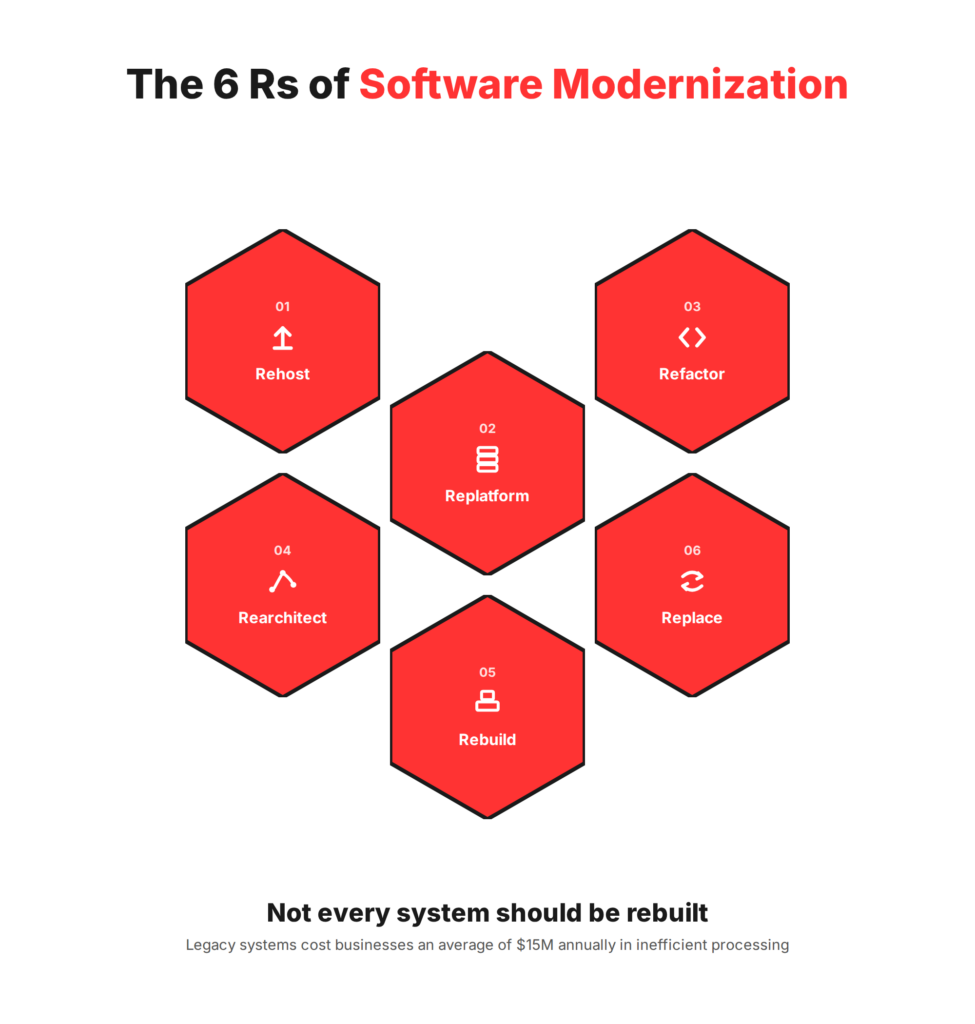
- Organizations running legacy software lose an average of $15 million annually from inefficient data processing, according to research cited by American Chase’s data practice.
- The right modernization approach depends on the system’s strategic value, technical debt level, and available timeline — not every system should be rebuilt.
- Phased migration strategies that run old and new systems in parallel are the safest approach for mission-critical applications with zero-downtime requirements.
- API modernization and microservices migration are the most common first steps for monolithic systems that need to scale without a full rebuild.
- Post-modernization support is as important as the migration itself — vendors who treat go-live as the end of their engagement leave clients without stability coverage at the highest-risk period.
Software modernization services help businesses upgrade outdated systems by replacing monolithic architectures, migrating to the cloud, or re-platforming legacy code without halting day-to-day operations. The right partner assesses risk, stages the migration, and preserves business logic throughout.
By reading this blog, you will learn what software modernization services include, the key approaches across the 6 Rs, how to evaluate vendors, and what a typical engagement looks like from assessment to go-live.
According to McKinsey’s 2024 technology modernization research, organizations that modernize legacy systems through cloud adoption reduce IT costs by up to 40 percent while increasing release velocity significantly. Yet most enterprise IT leaders report that fear of operational disruption is the primary reason modernization projects are delayed or cancelled before they begin.
What Is Software Modernization?
What Does Software Modernization Cover?
Software modernization services encompass the systematic upgrade of legacy applications, infrastructure, and data systems to modern architectures, cloud platforms, and development practices. It is distinct from a simple update or patch.
A patch fixes a known defect without changing the underlying architecture. Modernization changes how a system is structured, where it runs, how it integrates with other systems, or what technology it is built on. The scope can range from moving a single application to a cloud provider to rebuilding an enterprise platform from the ground up as a microservices architecture.
What Are the Signs Your System Needs Modernization?
Technical debt that accumulates faster than it can be repaid is the clearest indicator. Symptoms include integration failures between the legacy system and modern platforms, security vulnerabilities that cannot be patched because the underlying software is end-of-life, performance degradation under increasing load, and development teams spending more time maintaining the existing system than building new capabilities.
Compliance gaps are equally significant. Systems built before modern data privacy regulations came into effect often lack the access controls, audit logging, and encryption standards that regulations now require. Retrofitting these controls onto a system not designed for them is frequently more expensive than a structured modernization programme. Application modernization services address all of these failure modes through a structured assessment before any migration work begins.
What Are the 6 Rs of Software Modernization?
What Are Rehost, Replatform, and Refactor?
The 6 Rs provide a framework for deciding what to do with each component of a legacy system. The first three apply when the system is worth preserving.
Rehost moves the application to new infrastructure, typically cloud, with no changes to the code or architecture. It is the fastest and lowest-risk approach. The trade-off is that a rehosted application does not gain cloud-native benefits such as auto-scaling or managed services. It is the right choice for stable, low-complexity systems that need to exit on-premise infrastructure on a fixed timeline.
Replatform makes targeted infrastructure optimisations without changing the core application code. A common example is moving a self-managed database to a managed cloud database service such as Amazon RDS. Each change reduces operational overhead without requiring a code rewrite. This approach strikes the right balance for systems with moderate technical debt where the architecture is sound but the infrastructure is not.
Refactor redesigns the application at the code level to take advantage of modern capabilities. A monolith is broken into independently deployable services. The data layer is redesigned for cloud-native storage. Cloud and DevOps integrations embedded in a refactored system from the start ensure the architecture is maintainable and deployable through automated pipelines.
When Should You Rearchitect, Rebuild, or Replace?
The second three Rs apply when the existing system cannot be saved at a cost that is proportionate to its value.
Rearchitect involves preserving the application’s business logic while redesigning its structure entirely. This is appropriate when the logic is sound, but the architecture makes scaling, integration, or maintenance prohibitively expensive.
Rebuild starts from a clean codebase while retaining the functional specification of the original system Custom software development capability is required for a rebuild engagement.
Replace retires the legacy system entirely and adopts a commercial off-the-shelf or SaaS alternative that covers the same function.
What Does a Legacy Assessment and Technical Audit Cover?
A technical audit is the first deliverable of any credible modernization engagement. It inventories every component of the existing system, maps application dependencies, identifies integration points with external systems, evaluates technical debt severity by module, and classifies each component against the 6 Rs framework.
The audit produces a prioritised modernization roadmap that sequences which components to address first based on business risk, technical complexity, and available budget. Without this foundation, modernization efforts address symptoms rather than root causes, which is the most common reason modernization projects stall mid-execution.
How Does Cloud Migration Fit Into Modernization?
Cloud migration moves applications and data from on-premises infrastructure to AWS, Azure, or GCP. For legacy software modernization, the cloud migration is typically the infrastructure layer of a broader programme that also includes application refactoring and API re-engineering.
On-premise to cloud migration that is well-executed preserves data integrity throughout the transfer, maintains application availability during the transition, and produces a cloud environment that is right-sized for actual workload requirements. Poor cloud migrations reproduce on-premise inefficiencies in a cloud environment, which generates higher costs without the performance or agility benefits that justified the migration.
What Does API Integration and Microservices Migration Involve?
Monolithic applications bundle all functions into a single deployable unit. When one component requires scaling, the entire application scales, regardless of which components actually need additional capacity. Breaking a monolith into microservices allows each service to scale, deploy, and fail independently.
The migration from monolith to microservices is one of the most technically complex modernization programmes available. It requires domain analysis to identify service boundaries, API design for inter-service communication, data model decomposition, and incremental migration strategies that do not require a big-bang cutover.
Data modernization strategies are a frequent parallel workstream, as the data layer of a monolith often needs to be restructured when the application is decomposed.
Does UI/UX Modernization Need to Happen at the Same Time?
UI modernization replaces outdated user interfaces with modern, responsive designs without necessarily changing the underlying application logic. It is frequently the most visible deliverable of a modernisation programme and the one that end users experience most directly.
For organisations with large user bases on legacy interfaces, UI modernization can be sequenced ahead of bigger architectural changes to deliver early visible value while the more complex back-end work progresses. Web development capability is required to rebuild interfaces that meet current standards for accessibility, mobile responsiveness, and performance.
How Do You Modernize Without Disrupting Operations?
What Are Phased Migration Strategies?
Phased migration runs old and new systems in parallel during the transition period. Users access the new system for selected workflows or data domains while the legacy system continues to handle everything else. This approach eliminates the binary risk of a single cutover event and allows issues to be identified and resolved in a controlled subset of the workload before the full migration is committed.
The most commonly used phased approach is the strangler fig pattern, where new microservices progressively replace functions of the legacy monolith. Traffic is routed to the new service for each replaced function while the monolith continues to handle the remaining functions.
What Does Rollback Planning Require?
Every stage of a modernization programme should have a tested rollback procedure. A rollback plan defines the specific conditions that trigger a return to the previous state, the technical steps required to execute that return, and the time and cost involved. Plans that exist only on paper and have not been tested against the actual system are not rollback plans — they are assumptions.
Rollback testing should be conducted during the parallel operation phase when the cost of discovering a problem is low. Discovering a gap in the rollback procedure during a production cutover is the scenario that modernization programmes are specifically designed to avoid.
How Do You Choose a Software Modernization Partner?
What Criteria Matter Most for Vendor Evaluation?
Domain expertise in your technology stack and industry is the starting point. A vendor who has solved the same failure modes before will not solve them for the first time on your budget and timeline.
Security posture matters equally during modernization. Old and new systems running in parallel create elevated risk. The vendor’s access controls, data handling policies, and incident response procedures for this period must be reviewed explicitly, not assumed.
Post-migration support determines whether the vendor is a partner or a contractor. A partner catches performance issues, security vulnerabilities, and integration failures after go-live. A contractor who exits at go-live leaves the client without coverage at the highest-risk period in the system’s lifecycle.
What Questions Should You Ask Before Signing?
Before committing to a modernization vendor, ask these specific questions:
- How will you scope the assessment phase and what will the output document contain?
- Who owns the intellectual property of any new code written during the engagement?
- What is your rollback procedure if a migration stage fails, and has it been tested?
- What does your post-go-live support model cover and for how long?
- Can you provide references from clients with a system of similar complexity and industry context?
How Does American Chase Approach Software Modernization?
American Chase approaches legacy software modernization as a structured programme beginning with a technical audit that produces a prioritised modernization roadmap before any migration work begins.
Phased migration strategies with tested rollback procedures are the default for all mission-critical applications. Parallel operation periods are designed to be long enough to validate the new system under real load before the legacy system is decommissioned. Application modernization engagements include cloud migration, API re-engineering, microservices migration, and UI modernisation as integrated workstreams rather than separate projects.
For organisations modernizing SAP environments alongside their broader application estate, American Chase’s SAP practice and legacy modernization practice operate as a single team. For organisations incorporating generative AI development services into their modernized systems, the AI engineering capability is embedded in the same engagement rather than managed by a separate vendor. Visit americanchase.com to discuss your modernization requirements.
FAQs About Software Modernization Services
What are software modernization services?
Software modernization services help businesses upgrade outdated legacy systems through rehosting, replatforming, refactoring, rearchitecting, rebuilding, or replacing existing applications and infrastructure. Services typically include technical audit, migration execution, testing, and post-launch support.
How long does a software modernization project typically take?
A targeted rehosting project can complete in 4 to 8 weeks. A full refactoring or microservices migration for a large enterprise system typically takes 6 to 18 months. The total timeline is driven by system complexity, the number of integration dependencies, data migration scope, and how much parallel operation time is required before legacy decommissioning.
What is the difference between software modernization and software migration?
Software migration moves an application or data from one environment to another, typically from on-premises to cloud, with limited changes to the application itself. Software modernization changes the architecture, code structure, or technology stack of the application, not just where it runs. Migration is often a component of a modernization programme, not the same thing.
How much do software modernization services cost?
A targeted rehosting or replatforming project typically costs $50,000 to $200,000. A full refactoring or microservices migration for an enterprise application ranges from $200,000 to $1 million or more depending on scope. Rebuilding a large system from scratch can exceed $1 million. Post-migration support is typically priced separately as an ongoing managed service.
Can you modernize software without replacing it entirely?
Yes. Rehosting, replatforming, and refactoring all modernize a system without replacing it. The right approach depends on the system’s strategic value, technical debt level, and how much architectural change is required to achieve the modernization goals.
What risks are involved in legacy system modernization?
The primary risks are data loss or corruption during migration, operational disruption during the cutover period, integration failures between the new system and external dependencies, and scope creep that inflates budget and timeline.
What is the difference between rehosting and refactoring?
Rehosting moves an application to new infrastructure with no code changes. It is the fastest approach but delivers limited cloud-native benefit. Refactoring redesigns the application at the code level to take advantage of cloud capabilities, microservices, and modern development practices.
How do you modernize software without downtime?
Phased migration strategies that run old and new systems in parallel eliminate single-point cutover risk. Traffic is moved progressively from the legacy system to the new system as each migration stage is validated. Rollback procedures tested during the parallel phase allow rapid recovery if an issue is discovered. Zero-downtime deployment requires CI/CD pipelines and blue-green or canary release patterns.
What industries benefit most from software modernization?
Financial services, healthcare, manufacturing, logistics, and government agencies carry the highest concentration of mission-critical legacy systems. These industries have complex regulatory requirements, large data volumes, and high availability requirements that legacy systems increasingly cannot meet.
How do I know if my software needs modernization or replacement?
Modernization is appropriate when the system’s business logic is sound, and its architecture or infrastructure is what needs upgrading. Replacement is appropriate when the system’s business logic is embedded in undocumentable, unmaintainable code, when a commercial alternative covers the same function at lower total cost, or when modernization costs would exceed rebuild costs within a 3-year horizon.