TL;DR
- React is a JavaScript library by Meta for building fast, interactive user interfaces using reusable components.
- It handles the UI layer only, leaving architecture decisions to the development team.
- By reading this guide, you will know what React is, how it compares to Angular and Vue, and when to use it.
React framework is one of the most searched technology questions among product managers, CTOs, and founders evaluating their next web application build. The answer shapes hiring decisions, product architecture, and long-term maintenance costs.
According to the Stack Overflow Developer Survey 2024, React has been the most widely used web framework for the sixth consecutive year, used by 39.5 percent of professional developers globally. That adoption rate has direct implications for hiring, support, and ecosystem longevity.
This guide explains what React is, how it compares to Angular and Vue, which business use cases it suits best, and what to consider before committing to it for your next product.
What Is React?
Library vs Framework
React is technically a JavaScript library, not a full framework. This distinction matters for business buyers. A full framework like Angular prescribes how you structure your entire application: routing, state management, testing, and API communication are all handled by the framework itself.
React handles only the user interface layer. Routing, state management, and data fetching are handled by separate libraries that the development team selects and integrates. This flexibility is React’s greatest strength and its primary complexity. It gives experienced teams significant architectural freedom. It also means that less experienced teams can make inconsistent choices that create technical debt.
Component-Based Architecture
React builds user interfaces from components, which are self-contained pieces of UI that manage their own logic and appearance. A button, a navigation bar, a data table, and a modal are all components. Each is built once and reused wherever it is needed across the application.
This component model accelerates development significantly on complex products. A React web app development team building a SaaS dashboard does not rebuild the table component for every screen that needs one. They build it once, test it once, and reuse it across the entire application. Changes to that component propagate everywhere it is used, which makes large-scale updates faster and less error-prone.
The Virtual DOM Explained
The DOM is the browser’s representation of a web page. Updating it directly is slow, especially when many elements change simultaneously. React solves this with a virtual DOM, which is a lightweight copy of the real DOM kept in memory.
When data changes in a React application, React updates the virtual DOM first, compares it to the previous version, identifies exactly what changed, and updates only those specific elements in the real DOM. This process, called reconciliation, is why React applications feel fast even when handling large volumes of real-time data updates.
React vs Angular vs Vue: Which Should Your Business Choose?
React’s Strengths
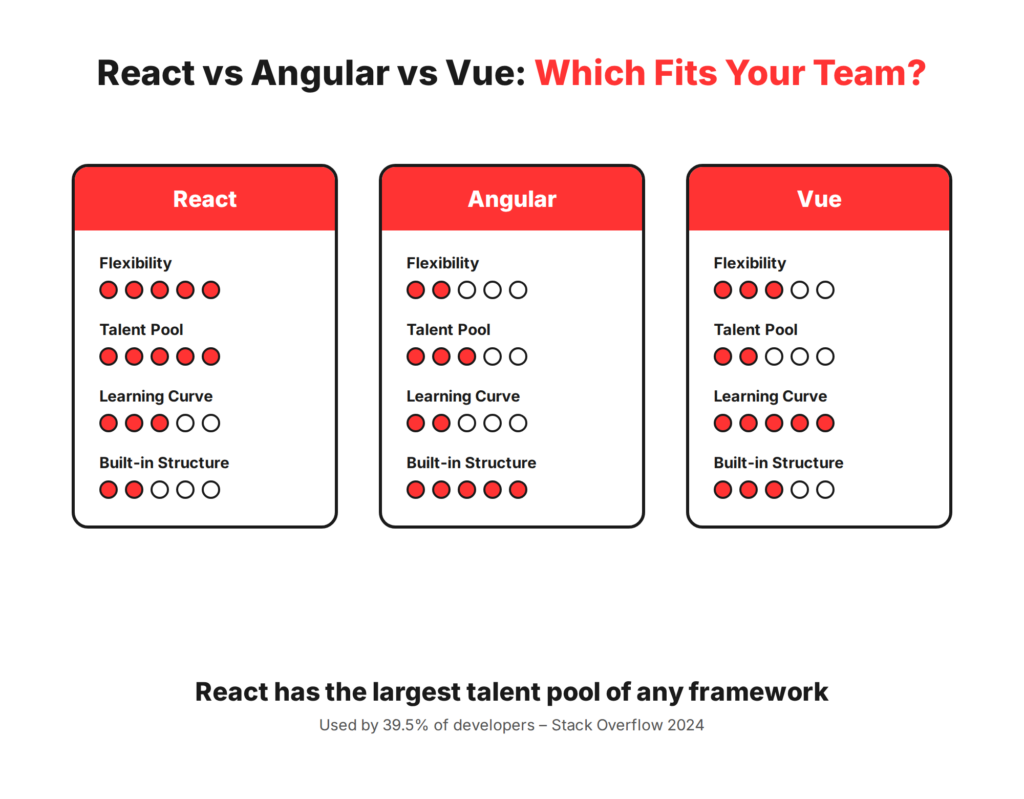
React’s primary advantages are its flexibility, the size of its developer ecosystem, and its path to mobile development through React Native. The React js framework has the largest talent pool of any front-end technology, which matters significantly for businesses planning to scale their engineering team or hire externally.
The React ecosystem includes mature libraries for every common requirement: React Router for navigation, Redux or Zustand for state management, React Query for data fetching, and Next.js for server-side rendering.
This breadth means that almost any product requirement has a well-supported solution available without building from scratch. Web development teams working in React also benefit from a large base of reusable open-source component libraries that accelerate UI development.
When Angular Is a Better Fit
Angular is a full framework maintained by Google. It is opinionated, meaning it prescribes how every part of the application should be structured. This makes Angular a strong choice for large enterprise teams where consistency across many developers matters more than flexibility.
Angular enforces TypeScript, includes a dependency injection system, and ships with testing utilities built in. For organisations with large engineering teams where different developers need to write code that looks the same, Angular’s conventions reduce the cognitive overhead of navigating between different parts of the codebase. React vs Angular vs Vue comparisons consistently show Angular winning on consistency for large teams and React winning on flexibility and ecosystem size.
When Vue Makes Sense
Vue is the most approachable of the three for teams new to component-based development. Its learning curve is gentler than React’s, and its documentation is widely regarded as the best of any major front-end framework.
Vue suits smaller teams working on projects where prototyping speed matters and where the team does not need React’s cross-platform capabilities through React Native. For businesses whose primary development language is Python or PHP and who are adding a front-end layer for the first time, Vue’s lower barrier to entry can accelerate initial delivery. The trade-off is a smaller talent pool and a smaller ecosystem than React.
Business Use Cases Where React Excels
SaaS Products and Dashboards
React’s component model is purpose-built for complex, data-heavy interfaces that update frequently. A SaaS analytics dashboard displaying real-time metrics, filterable tables, interactive charts, and customisable widgets is exactly the kind of interface where React’s virtual DOM and component reuse deliver the most value.
React framework advantages are most visible when a UI has many independent pieces that need to update without refreshing the entire page. SaaS products almost universally fit this description, which is why React is the dominant choice for SaaS front-end development.
E-Commerce Frontends
High-performance e-commerce storefronts need fast load times, real-time cart updates, dynamic product filtering, and personalised recommendations, all updating independently without full page reloads. React handles all of these requirements cleanly through its component architecture and state management ecosystem.
Large e-commerce platforms including Airbnb and Shopify’s merchant-facing interfaces use React specifically because its performance at scale and its component reuse capabilities reduce the complexity of maintaining a large product catalogue interface. Custom software development engagements building e-commerce platforms on React consistently report faster feature iteration cycles compared to traditional server-rendered approaches.
Internal Enterprise Tools
Custom admin panels, internal reporting dashboards, operational monitoring tools, and employee self-service portals are high-value React use cases that are frequently underestimated. These tools are used daily by internal teams and have a direct impact on operational efficiency, but they receive less attention than customer-facing products during vendor selection.
React for enterprise applications in this category benefits from React’s reusable component model because internal tools share many common interface patterns: data tables, form inputs, status indicators, and notification systems. Building a shared component library once and applying it across all internal tools dramatically reduces the cost of building and maintaining the internal tooling ecosystem.
What to Consider Before Choosing React for Your Project
Team Expertise and Hiring
React has the largest developer talent pool of any front-end technology globally. This matters for three reasons: it is easier to hire React developers than Angular or Vue developers, the freelance and agency market for React is more competitive and therefore more price-efficient, and the long-term risk of losing key engineers and being unable to replace them is lower.
For businesses making a multi-year product investment, the talent availability argument for React is often as compelling as the technical argument. A technology choice that is difficult to staff creates long-term dependency risk that compounds as the codebase grows. Mobile app development teams that want to share component logic between a web application and a mobile app can do so through React Native, reducing the total engineering investment needed for multi-platform product strategies.
SEO and Server-Side Rendering
Standard client-side React applications have historically performed poorly for SEO because search engine crawlers see an empty HTML shell before JavaScript executes and populates the page content. This is a real limitation for content-driven applications where organic search is a primary acquisition channel.
Next.js, the React-based framework developed by Vercel, solves this through server-side rendering and static generation. Next.js pre-renders React components on the server, delivering fully formed HTML to search engine crawlers and to users on slow connections. For any React application where SEO matters, Next.js is the standard architecture and should be part of the initial technical discussion rather than a retrofit after launch.
Long-Term Maintenance and Ecosystem Stability
React is maintained by Meta and supported by one of the largest open-source communities in software development. React 18 introduced concurrent rendering features that make large-scale applications significantly more responsive. The React core team publishes a clear versioning and deprecation policy, and major version changes have historically been accompanied by migration tools that reduce the cost of upgrading.
The ecosystem stability argument for React is strong. A technology backed by Meta, used by millions of production applications globally, and supported by a mature ecosystem of libraries and tooling is not going to disappear or become unmaintained on a short horizon. Cloud and DevOps integrations that support automated testing and deployment for React applications further reduce long-term maintenance overhead by catching regressions before they reach production.
How American Chase Builds React Applications
Our React Development Approach
American Chase builds React applications for enterprise clients using a structured process that begins with an architecture decision phase before any code is written. This phase defines the state management approach, routing strategy, component library selection, testing methodology, and deployment pipeline before the sprint cycle begins.
Every React engagement starts with a shared component library built to the client’s design system. This ensures visual consistency across the application from the first sprint rather than requiring a costly harmonisation effort after delivery. MVP development engagements built on React follow the same component library approach at a reduced initial scope, ensuring that the MVP codebase scales cleanly into the full product rather than requiring a rewrite.
Post-launch, the same engineering team handles performance monitoring, dependency updates, and feature development. React’s ecosystem moves quickly, and dependencies require regular review to maintain security and performance standards. Visit americanchase.com to discuss your React development requirements.
FAQs About the React Framework
What is the React framework and what is it used for?
React is a JavaScript library developed by Meta for building fast, interactive user interfaces. It is used to build web applications, SaaS products, e-commerce frontends, internal dashboards, and mobile apps through React Native. React handles the UI layer only, with routing, state management, and data fetching handled by separate libraries chosen by the development team.
Is React a library or a framework?
React is technically a UI library, not a full framework. It handles only the user interface layer. A full framework like Angular prescribes routing, state management, and testing tools. React leaves those decisions to the development team, which provides flexibility but requires experienced engineers to make consistent architectural choices across a large codebase.
What is the difference between React and React Native?
React is used to build web applications that run in a browser. React Native is a separate framework that uses React’s component model to build native mobile applications for iOS and Android. The two share similar syntax and component patterns, which allows development teams to share logic between a web application and a mobile app while maintaining separate UI layers for each platform.
How does React compare to Angular for enterprise development?
React offers greater flexibility and a larger talent pool. Angular offers more prescriptive structure that enforces consistency across large teams. React is the better choice for teams that want architectural freedom and cross-platform mobile capability. Angular is the better choice for large enterprise teams where consistent conventions across many developers matter more than flexibility in technology selection.
Is React good for SEO?
Standard client-side React has SEO limitations because pages are rendered by JavaScript after the initial HTML is delivered. Next.js, the React-based framework by Vercel, solves this through server-side rendering and static generation that delivers fully formed HTML to search engines.
How long does it take to build a React application?
A focused React application covering core functionality takes 8 to 16 weeks. A full-featured product with complex back-end integrations, a custom design system, and advanced state management takes 4 to 9 months. Timeline is driven by back-end complexity and integration scope rather than the React layer itself, which adds minimal overhead to a well-scoped web application project.
What is the virtual DOM in React?
The virtual DOM is a lightweight copy of the browser’s real DOM that React keeps in memory. When data changes, React updates the virtual DOM, compares it to the previous version, identifies only the elements that changed, and updates those specific elements in the real DOM.
Is React suitable for large-scale enterprise applications?
Yes. React is used in production by Facebook, Instagram, Airbnb, Netflix, and thousands of enterprise SaaS companies. Its component architecture scales well as applications grow in complexity, and its large ecosystem provides mature solutions for every common enterprise requirement.
What is Next.js and how does it relate to React?
Next.js is a React-based framework developed by Vercel that adds server-side rendering, static generation, file-based routing, and built-in API routes to React applications. It solves React’s original SEO limitations and simplifies the configuration required for production React deployments. Next.js has become the standard architecture for React web applications that require strong SEO performance or fast initial page load times.
How much does React development cost?
A focused React application typically costs $30,000 to $80,000. A full-featured React product with custom design system, complex state management, and back-end integration ranges from $80,000 to $250,000. Costs are driven primarily by back-end complexity, integration scope, and design complexity rather than the React layer.