TL;DR
- A monolithic architecture builds an application as a single unified codebase; microservices break it into independently deployable services communicating over APIs.
- Monoliths offer lower operational overhead; microservices offer independent scaling and team autonomy at the cost of added complexity.
- This guide covers the architectural trade-offs of each model, hybrid approaches, and how to decide which fits your business.
Monolith vs microservices is the most consequential architectural decision a software team makes, and the wrong answer is not always the one that sounds technically inferior. Monolithic systems power some of the world’s largest products. Microservices architectures have failed teams that adopted them before they were ready for the operational complexity they require.
According to Martin Fowler’s foundational microservices research, the primary cost of microservices is the operational complexity of managing a distributed system. That cost is worth paying for the right teams at the right scale. It is not worth paying for every team or every product stage.
Monolithic Architecture: A Controlled Scalability Model
Why Some Enterprises Still Prefer It
A monolithic application deploys as a single unit. The entire codebase, all business logic, all data access layers, and all UI components are bundled together and deployed together. When a change is made, the whole application is tested and redeployed.
This simplicity has real operational advantages. There is one codebase to maintain, one deployment pipeline to manage, one set of logs to query when something goes wrong, and one technology stack for the team to master. For applications where the domain is well understood, and the team is small, a monolith is consistently faster to build, test, and debug than an equivalent distributed system.
Scalability Bottlenecks
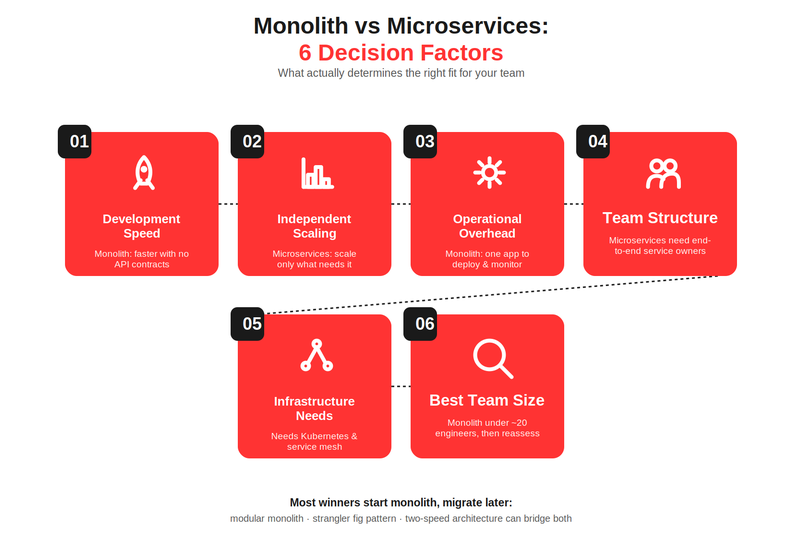
Monoliths scale vertically. When the application needs more capacity, the answer is a larger server or more servers running the entire application. Every component, including components that do not need more capacity, scales with every other component.
This becomes a problem when different parts of the application have dramatically different scalability requirements. An e-commerce checkout service that handles ten times its normal load during a promotional event has very different capacity needs from the product search service running alongside it. In a monolith, both scale together regardless of which needs the capacity.
Microservices Architecture: The Federated Scalability Model
Why Enterprises Shift to Microservices
Microservices decompose the application into independently deployable services, each responsible for a bounded domain. The checkout service, the product search service, the inventory service, and the notification service are each their own deployment unit with their own data store, their own API contract, and their own release cycle.
This independence enables three things that monoliths cannot provide at scale. First, each service scales independently based on its own load, eliminating the waste of scaling low-traffic services alongside high-traffic ones. Second, teams own services end-to-end and can deploy changes without coordinating with every other team, dramatically increasing development velocity across large organisations. Cloud and DevOps integrations embedded in the CI/CD pipeline from the start of a microservices project are not optional overhead but essential infrastructure that determines whether independent deployment is operationally sustainable.
Scalability Trade-Offs and Pitfalls
Microservices introduce distributed systems complexity that monoliths do not have. Network calls replace in-process function calls. Services can fail independently. Data consistency across service boundaries requires explicit design rather than the implicit transactional consistency of a single database. Debugging a transaction that spans five services requires distributed tracing tooling that a monolith’s single log stream does not need.
The teams that struggle most with microservices are those that adopt the architecture before they have the operational maturity to manage it. Container orchestration, service mesh configuration, distributed tracing, and automated deployment pipelines are all prerequisites for microservices to deliver their promised benefits rather than their complexity costs.
Architectural Trade-Offs in Scaling Enterprise Systems
Development Speed and Complexity
In the early stages of a product, a monolith is almost always faster to build. There are no API contracts to define between services, no network failure modes to handle, no distributed consistency problems to solve. A small team building a new product can ship features in a monolith weeks faster than in an equivalent microservices architecture.
As the product and team grow, this relationship inverts. Coordinating changes across a large monolith becomes the bottleneck. Services that were grouped together for convenience become entangled in ways that make isolated changes difficult. The coupling that made the monolith fast to build initially makes it slow to change at scale.
Operational Overhead
Operating a monolith requires deploying, monitoring, and debugging one application. Operating a microservices architecture requires deploying, monitoring, and debugging dozens or hundreds of services, each with its own resource allocation, its own failure modes, and its own dependency graph.
This operational overhead is the most frequently underestimated cost of microservices adoption. Teams that have not invested in Kubernetes, service mesh, distributed tracing, centralised logging, and automated testing infrastructure before adopting microservices typically experience significant instability in the first months of production operation.
Strategic Decision Framework
Key Factors in Architectural Decision-Making
The right architecture is determined by the intersection of current scale, growth trajectory, team size, and operational maturity rather than by which architecture sounds more modern.
Monolith is typically the right choice when:
- The team is fewer than 15 to 20 engineers
- The domain is not yet well enough understood to draw reliable service boundaries
- Speed of initial development is the primary constraint
- The organisation does not yet have DevOps infrastructure to manage distributed deployments
Microservices are typically the right choice when:
- The team is large enough that deployment coordination is becoming a bottleneck
- The domain is well understood, and natural service boundaries are clear
- Different parts of the system have demonstrably different scalability requirements
- The organisation has the DevOps maturity to operate a distributed system reliably
Team Expertise and Development Culture
Conway’s Law states that organisations design systems that mirror their own communication structures. A team organised into functional silos will produce a monolith whether they intend to or not. A team organised into product-oriented squads with end-to-end ownership of services will naturally tend toward microservices.
This means that architectural choice is as much an organisational design decision as a technical one. Adopting microservices without reorganising teams to own services end-to-end typically produces a distributed monolith, which combines the operational complexity of microservices with the deployment coupling of a monolith, achieving the disadvantages of both without the benefits of either.
Infrastructure and Deployment Considerations
Microservices require significantly more infrastructure than a monolith of equivalent functionality. Container orchestration through Kubernetes, a service mesh for inter-service communication, centralised logging across all services, distributed tracing for cross-service transactions, and a mature CI/CD pipeline that enables independent service deployment are all baseline requirements.
This infrastructure investment is justified at sufficient scale and organisation size. It is premature for small teams and early-stage products where the operational overhead exceeds the scalability benefit that microservices deliver. Web development teams that are evaluating their architecture at an early product stage should apply this framework honestly rather than defaulting to microservices because they are more technically interesting.
Hybrid Approaches: The Best of Both Worlds?
Modular Monolith
A modular monolith is a monolithic deployment with an internal architecture that enforces service-like boundaries between modules. Each module owns its domain and exposes a well-defined interface to other modules. The application deploys as a single unit but can be refactored into microservices later because the module boundaries already exist.
This approach delivers some of the organisational benefits of microservices, including clearer domain ownership and isolated change, without the operational complexity of distributed deployment. For teams considering microservices adoption, a modular monolith is often the right intermediate step rather than a direct migration.
Strangler Fig Pattern for Migration
The strangler fig pattern migrates a monolith to microservices incrementally rather than through a full rewrite. New functionality is built as microservices from the start. Existing monolith functionality is extracted into services incrementally, with the monolith remaining in production until each component has been successfully migrated and validated.
This approach eliminates the risk of a big-bang migration where the entire monolith is rewritten simultaneously. Each migrated service goes through the full testing and deployment cycle independently, allowing issues to be identified and resolved incrementally rather than at a single high-risk go-live event.
Two-Speed Architecture
A two-speed or bimodal architecture runs stable, low-change components as a monolith and fast-moving, high-change components as microservices. The financial reporting module that changes quarterly runs in the monolith. The recommendation engine that deploys daily runs as a microservice. This hybrid approach allows organisations to apply the right architecture to each workload rather than choosing a single model for the entire system.
How American Chase Helps Businesses Choose and Build the Right Architecture
Our Architecture Assessment Process
American Chase evaluates monolithic architecture vs microservices decisions through an architecture assessment that maps the client’s current team structure, deployment frequency, scalability requirements, and DevOps maturity before recommending an approach. This assessment prevents the common failure mode of recommending microservices because they are technically sophisticated rather than because they match the team’s actual context.
Migration Support for Growing Products
For products that have outgrown their monolithic architecture, American Chase supports incremental migration using the strangler fig pattern, extracting services from the monolith in priority order based on independent scalability needs and team ownership alignment. Visit americanchase.com to discuss your architecture requirements.
FAQs About Monolith vs Microservices
What is the main difference between monolith and microservices architecture?
A monolith deploys as a single unified codebase where all components are coupled and scaled together. Microservices decompose the application into independently deployable services, each owning its domain, data store, and release cycle. The primary trade-off is operational simplicity in a monolith versus independent scalability and team autonomy in microservices.
Should a startup use microservices from day one?
Rarely. Startups benefit from the development speed of a monolith in the early stages when the domain is not yet well understood, and team size does not justify the operational overhead of distributed systems. Most successful microservices architectures began as monoliths and migrated incrementally as the team, domain, and scale justified the added complexity.
What are the biggest challenges of microservices architecture?
The biggest challenges are distributed systems complexity, including network failures and data consistency across services, the operational overhead of managing dozens of independently deployed services, the need for mature DevOps infrastructure before microservices can be deployed reliably, and the organisational change required to restructure teams around service ownership rather than functional specialisation.
How do I know when to migrate from a monolith to microservices?
Migrate when deployment coordination is a measurable bottleneck on development velocity, when different components have demonstrably different scalability requirements, when team size has grown beyond 20 engineers working in the same codebase, and when the organisation has invested in the DevOps infrastructure required to operate a distributed system reliably in production.
Is a monolith always easier to build than microservices?
Yes, at the initial development stage. A monolith has no API contracts to define, no network failure modes to handle, and no distributed consistency problems to solve. The difficulty of a monolith grows with scale as components become coupled and coordinating changes across teams becomes the bottleneck. Microservices are harder initially but scale better organisationally.
Can a business use a hybrid of monolith and microservices?
Yes. A modular monolith applies service-like internal boundaries within a single deployment. A two-speed architecture runs stable components as a monolith and fast-moving components as microservices. Both approaches allow organisations to apply the right architecture to each workload rather than choosing a single model for the entire system.
What is the strangler fig pattern for migration?
The strangler fig pattern migrates a monolith to microservices by building new functionality as microservices from the start and extracting existing monolith functionality incrementally over time. The monolith remains in production throughout, shrinking as each component is successfully migrated and validated. This eliminates the risk of a full rewrite and allows issues to be identified incrementally.
How does team structure affect the choice between monolith and microservices?
Conway’s Law predicts that systems mirror their organisation’s communication structure. Teams organised by function produce monoliths. Teams organised by product domain with end-to-end service ownership produce microservices. Adopting microservices without reorganising teams to own services end-to-end typically produces a distributed monolith that combines the operational complexity of microservices with the deployment coupling of a monolith.
Do microservices always improve performance?
No. Microservices replace in-process function calls with network calls, which introduces latency that monoliths do not have. Services that need to coordinate multiple data sources across service boundaries add additional round trips. Performance improvements in microservices come from independent scaling of high-load services, not from the distributed architecture itself, which adds overhead rather than reducing it.
What tools are needed to manage a microservices architecture?
A production microservices architecture requires container orchestration such as Kubernetes, a service mesh for inter-service communication and observability, centralised logging across all services, distributed tracing for cross-service transaction debugging, a mature CI/CD pipeline enabling independent service deployment, and API gateway tooling for managing external-facing service endpoints and authentication.