TL;DR
- App development follows 7 stages: discovery, planning, UI/UX design, development, testing, deployment, and post-launch maintenance — skipping any stage increases cost and risk significantly.
- The discovery stage is the most underinvested stage in failed app projects; poor problem definition is the leading cause of product-market fit failure.
- UI/UX design and user testing before development begins prevent expensive mid-build redesigns that can add 30 to 50 percent to the total project cost.
- Agile development in two-week sprints keeps projects visible and adjustable, unlike waterfall approaches where problems surface only at the end.
- Testing must include unit, integration, performance, and user acceptance testing — apps that skip formal QA see 15 times higher post-launch defect costs than those that test thoroughly.
- Post-launch maintenance is not optional; apps that are not actively monitored and iterated lose 77 percent of their daily active users within the first three days after launch.
Understanding what are the 7 stages of app development are is the difference between a product that launches on time and one that overruns budget by 40 percent and ships with defects that users never forgive.
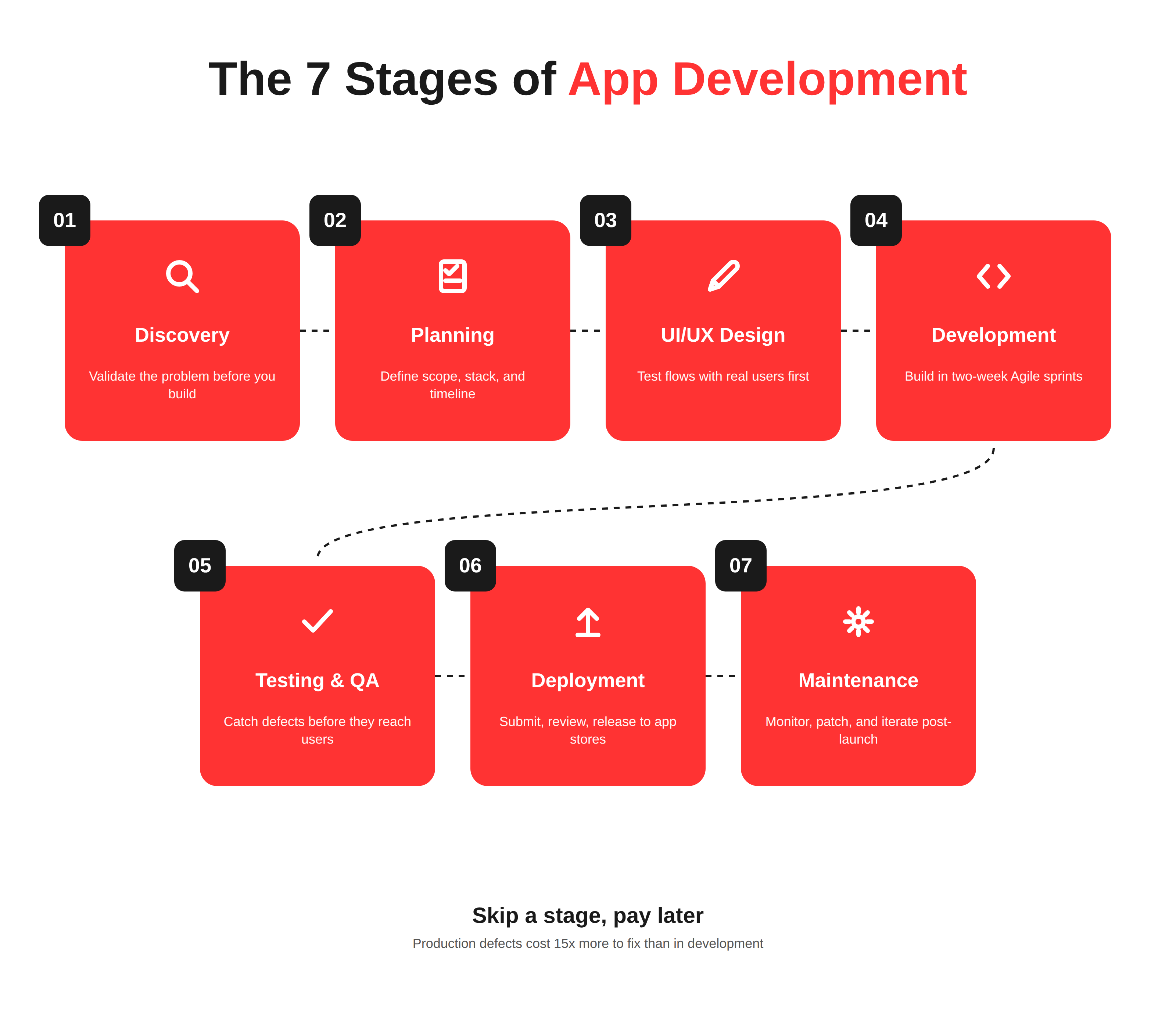
According to a 2026 analysis from American Chase’s mobile strategy practice, over 2.4 million apps exist on Google Play and 1.9 million on the App Store — yet only 1 in 100 achieves lasting commercial success. The distinguishing factor is almost always whether the development team followed a disciplined stage-based process or rushed to code without adequate planning.
This guide walks through every stage of the mobile app development lifecycle, who is involved at each phase, what deliverables to expect, and how to keep your project on track from kickoff to launch.
Why Does App Development Have Defined Stages?
Defined stages exist because app development is a sequence of dependent decisions, not a parallel set of independent tasks. What is decided in discovery constrains what is designed. What is designed constrains what is built. What is built constrains what can be tested and deployed.
What Happens When Teams Skip Stages?
When teams skip planning to start coding faster, they build the wrong thing. When they skip design validation, they build something users do not understand. When they skip testing, they ship defects that are 15 times more expensive to fix in production than in development — a figure cited consistently across software engineering research.
A real example: Snapchat’s 2018 redesign was shipped without adequate user testing. The resulting backlash drove a petition signed by 1.2 million users and contributed to a 224 million dollar revenue miss in the following quarter. The cost of skipping user validation is rarely theoretical.
How Do the Stages Connect?
Each stage feeds the next. A weak discovery produces a flawed plan. A flawed plan produces an inaccurate design. An inaccurate design produces misdirected development. Problems introduced early in the lifecycle multiply in cost as they cascade forward. This is why front-loading investment in discovery and planning consistently produces lower total project cost than rushing to development.
Stage 1: What Happens During Discovery and Ideation?
Discovery is the stage where the product idea is pressure-tested against real user needs and market reality. Its purpose is to answer one question clearly before any money is spent on building: does this problem exist at a scale that justifies building a solution?
How Do You Define the Problem and User Need?
The discovery team must answer four questions before moving forward. Who is the user and what specific problem are they experiencing? How are they solving this problem today without the app? What makes their current solution inadequate? And what would need to be true for them to switch to the new product?
These questions sound simple. In practice, most product teams answer them with assumptions rather than research, which is why 42 percent of startups fail due to no market need, according to CB Insights’ analysis of startup failure.
Why Does Competitive Research Matter?
Competitive research identifies what already exists, where existing solutions fall short, and what positioning the new product needs to occupy. It prevents building a product that is a marginally better version of something that already has strong market incumbents. The output of discovery is a validated problem statement and a clear user persona that guides every subsequent decision.
Stage 2: What Does Planning and Requirement Analysis Cover?
Planning translates the validated problem statement into a technical and operational blueprint. This is where scope is defined, resources are allocated, and timelines are set. It is also where the most expensive decisions in the project are made, even though they require no code.
What Belongs in a Software Requirements Specification?
A Software Requirements Specification (SRS) document defines every feature the app must include, every system it must integrate with, every performance requirement it must meet, and every edge case it must handle. Its value is not in the document itself but in the conversations it forces between stakeholders and the development team before assumptions become expensive mistakes.
How Does Platform Choice Affect Cost and Timeline?
Choosing between native iOS, native Android, and cross-platform development has significant cost implications. Native development for both platforms doubles the engineering effort. Cross-platform frameworks like React Native and Flutter produce near-native quality applications from a single codebase, reducing cost by 30 to 40 percent and time-to-market by up to 40 percent according to Developer Economics surveys. For most MVP development projects, cross-platform is the right default unless platform-specific features are required.
Stage 3: Why Does UI/UX Design Matter Before Development?
UI/UX design translates requirements into the interfaces that users will actually interact with. Its position before development is not arbitrary. Design is the cheapest stage at which to discover that a flow does not work for users. Changing a wireframe costs hours. Changing the same flow in code costs days or weeks.
What Are Wireframing and Prototyping?
Wireframing creates low-fidelity structural representations of every screen in the application. They show layout, navigation, and content hierarchy without colour or visual design. Prototyping links wireframes into clickable flows that simulate the app experience without functional code. Both allow user testing before development begins, which is the highest-leverage quality investment in the entire project.
How Does User Testing Before Development Work?
User testing at the prototype stage involves observing 5 to 8 representative users completing core tasks in the clickable prototype. The goal is to identify where users get confused, where they take unexpected paths, and where their mental model of the app differs from the designer’s. Research by Nielsen Norman Group consistently shows that 5 users uncover 85 percent of usability problems. Running this test before development saves the cost of building screens that do not work.
Stage 4: How Does Development Actually Work?
Development is the stage where the designed interfaces are built into functional software. It is typically the longest stage and the most resource-intensive. For most custom software development projects, development runs in iterative two-week sprint cycles rather than as a single linear build.
What Is the Difference Between Frontend and Backend Development?
Frontend development builds the visual interface layer, the screens and interactions that users see and interact with. Backend development builds the server logic, database, APIs, and the business rules that power what users see. The two layers communicate through APIs. For most modern apps, the frontend and backend are developed in parallel by separate team members, with regular integration points to ensure both layers remain aligned. Web development and mobile frontend share many architectural patterns, particularly in React Native and Next.js ecosystems.
How Do Agile Sprints Keep Projects on Track?
Agile development runs in two-week cycles, each producing a working increment of the product that is demonstrated to stakeholders at the end of the sprint. This approach surfaces problems early, keeps the product team engaged throughout development rather than at a single final handover, and allows scope adjustments based on what is learned from each increment. Cloud and DevOps integrations that automate testing and deployment further reduce the overhead between sprints.
Stage 5: What Testing Does Every App Need?
Testing validates that what was built matches what was specified and that it performs reliably under realistic conditions. It is not a single activity at the end of development. It runs continuously throughout the build phase and intensifies before deployment.
What Are the Different Types of Testing?
Unit testing verifies that individual functions and components behave as expected in isolation. Integration testing verifies that components work correctly when combined. Performance testing validates that the app maintains acceptable response times and stability under realistic concurrent user loads. User acceptance testing (UAT) involves real users or stakeholders verifying that the app meets the original requirements and is ready for launch.
What Does QA Failure Look Like Post-Launch?
The business cost of shipping without thorough testing is predictable and severe. A one-star review citing crashes or bugs is seen by every potential user who searches the app store. App store ratings below 4.0 reduce download conversion rates by more than 50 percent according to Apptentive’s App Attention Index. Fixing defects in production costs 15 times more than fixing them in the development phase.
Stage 6: What Does Deployment Involve?
Deployment is the process of making the app available to users. For mobile apps, this means submitting to the Apple App Store and Google Play, passing their respective review processes, and managing the release to ensure a smooth user experience from day one.
What Do App Store Submission and Approval Require?
Apple’s App Store review typically takes 24 to 48 hours for standard submissions, though complex apps or those flagging automated policy checks can take longer. Google Play review typically completes within hours to 3 days. Both platforms require specific metadata, screenshots, privacy policy URLs, and compliance with their content and technical guidelines. Rejection at this stage delays launch and can require code changes, which is why compliance should be designed in from Stage 2.
Why Do CI/CD Pipelines Matter for Deployment?
Continuous Integration and Continuous Deployment (CI/CD) pipelines automate the build, test, and deployment process. Every code change triggers an automated test suite, and passing builds can be deployed to staging or production without manual steps. This reduces human error, accelerates release cycles, and provides an audit trail for every change deployed to production.
Stage 7: What Does Post-Launch Maintenance Cover?
Post-launch maintenance is the ongoing work that keeps the app functional, secure, and aligned with evolving user needs and platform requirements. It is not an optional phase. Operating systems update, user behaviour evolves, and security vulnerabilities are discovered continuously after launch.
How Should You Monitor Performance After Go-Live?
The minimum post-launch monitoring setup tracks crash rate, average session duration, daily active users, and key in-app funnel conversion rates. Tools such as Firebase Crashlytics, Mixpanel, and Sentry surface crash reports and user behaviour patterns in real time, giving the product team actionable data within hours of a problem emerging.
How Do You Plan the Next Release Cycle?
User feedback from app store reviews, in-app survey tools, and support tickets generates the backlog for the next release cycle. Prioritisation should be driven by the frequency of requests, the severity of bugs, and alignment with the product strategy defined in Stage 1. A product that iterates systematically based on user feedback consistently outperforms one that releases features based on internal assumptions.
How Does American Chase Manage the App Development Lifecycle?
American Chase structures every mobile app development engagement across all 7 stages, beginning with a structured discovery and planning phase that produces a validated SRS before any design or development work begins.
Design is validated with real users at the wireframe and prototype stage, before development starts. Development runs in two-week Agile sprints with client demos at the end of each cycle. QA is integrated throughout the build phase, not treated as a final gate. Deployment preparation begins in parallel with final testing, not after it.
Post-launch, American Chase provides monitoring, maintenance, and iteration support from the same team that built the product. Visit americanchase.com to discuss your app development project.
FAQs About the 7 Stages of App Development
What are the 7 stages of app development?
The 7 stages are discovery and ideation, planning and requirement analysis, UI/UX design, development, testing and quality assurance, deployment, and post-launch maintenance. Each stage produces specific deliverables that feed into the next. Skipping any stage increases the risk of cost overruns, poor user adoption, and technical debt that is expensive to resolve after launch.
How long does each stage of app development take?
Discovery takes 1 to 2 weeks. Planning takes 1 to 2 weeks. UI/UX design takes 2 to 4 weeks. Development takes 8 to 20 weeks depending on scope. Testing takes 2 to 4 weeks. Deployment takes 1 to 2 weeks. Post-launch maintenance is ongoing. Total time from kickoff to launch for a medium-complexity app typically ranges from 4 to 9 months.
What happens during the discovery phase of app development?
Discovery validates the problem the app is solving, defines the target user, analyses the competitive landscape, and produces a clear product brief before any design or development begins. It prevents the most expensive mistake in app development: building something that solves a problem users do not actually have or that duplicates an existing solution with no differentiation.
Can you skip the UI/UX design stage if you have a simple app?
No. Even simple apps benefit from wireframing and user testing before development. The cost of changing a flow at the wireframe stage is measured in hours. The cost of the same change after development is measured in days or weeks. Skipping design validation is one of the most consistent sources of mid-project scope changes that inflate budgets.
What is the difference between QA testing and UAT?
QA testing is conducted by the development or testing team to verify that the app functions as specified technically. UAT (user acceptance testing) is conducted by actual users or business stakeholders to verify that the app meets real-world requirements and is ready for launch. Both are required. QA catches technical defects; UAT catches requirement misalignments that technical testing cannot surface.
How much does it cost to go through all 7 stages of app development?
A basic single-platform app covering all 7 stages typically costs $30,000 to $80,000. A medium-complexity app with backend development, integrations, and multi-platform deployment ranges from $80,000 to $200,000. Complex enterprise apps exceed $200,000. See MVP development cost guides for detailed breakdowns by feature scope and team model.
What is the most important stage in app development?
Discovery is the highest-leverage stage because every subsequent decision depends on the clarity of the problem definition and user understanding established there. However, testing is the stage whose absence is most visibly damaging, as defects that reach production cost 15 times more to fix than those caught during the QA phase and directly damage user ratings and retention.
Do all apps follow the same development stages?
The 7 stages apply universally, though the duration and depth of each varies by app complexity, team size, and methodology. An enterprise app with complex integrations spends more time in planning and testing than a simple consumer utility. Agile projects run stages iteratively and in parallel rather than sequentially, but all 7 stages are still present.
What is the role of a product manager during app development stages?
The product manager owns the product vision throughout all 7 stages. In discovery, they lead research and validation. In planning, they define scope and prioritise features. During development, they manage the backlog, clarify requirements, and attend sprint demos. In testing, they own UAT sign-off. Post-launch, they analyse metrics and drive the next release cycle prioritisation.
What happens after an app is launched — is development over?
Development is never over after launch. Post-launch maintenance covers crash monitoring, security patching, operating system compatibility updates, feature iteration based on user feedback, and performance optimisation. Apps that are not actively maintained lose users rapidly — 77 percent of daily active users are lost within 3 days of install without ongoing engagement and improvement investment.