Look, you’ve got an app idea that’s keeping you up at night. Maybe it’s the next big thing in fintech, or a solution that’ll make people’s lives genuinely easier. But here’s the million-rupee question – or should we say, the multi-lakh question: how much is this actually going to cost you?
Here’s the deal: building a mobile app in India isn’t like buying a car with a fixed sticker price. It’s more like building a house – the cost depends on whether you’re going for a studio apartment or a sprawling mansion with all the bells and whistles.
In 2026, the mobile app development cost in India ranges anywhere from ₹5 lakh to ₹80 lakh ($6,000 to $95,000). That’s a huge spread, right? Don’t worry – by the time you finish reading this, you’ll know exactly where your project sits on that spectrum and how to make every rupee count.
We’re breaking down the real numbers, the hidden costs nobody tells you about, and the insider strategies that’ll help you build a killer app without burning through your budget. No fluff, no jargon – just straight talk about what it actually takes to turn your app idea into reality.
Why India’s the Sweet Spot for App Development
Before we dive into the numbers, let’s talk about why businesses worldwide are looking to India for their app development needs. Spoiler alert: it’s not just about the cost savings.
India’s mobile app development market is projected to hit $20.7 billion by 2026, growing at a compound annual growth rate of 21.7%. That’s not just growth – that’s explosive momentum driven by a perfect storm of talent, tech infrastructure, and competitive pricing.
Here’s what makes India different. You’re not compromising quality for cost – you’re getting both. Indian developers aren’t just coding; they’re building apps that compete globally while charging 60-70% less than their Western counterparts. It’s like getting champagne at beer prices.
And the talent pool? It’s massive. India’s the world’s number one market for mobile app downloads, with smartphone penetration expected to cross 50% by 2026. When you’re building apps in a market this hungry for mobile solutions, developers naturally get good at what they do.
Plus, with 5G rolling out and 700 million 5G subscriptions expected by 2028, Indian developers are already building for the future – AR experiences, real-time everything, and AI that actually makes sense.
The Real Numbers: What You’ll Actually Pay

Let’s cut through the confusion. Here’s what different types of apps actually cost in India right now.
Simple Apps: Your MVP Sweet Spot (₹5-15 Lakh)
Think of this as your entry ticket – lean, focused, and built to validate your idea without betting the farm.
What you get for ₹5-15 lakh ($6,000-$18,000):
- User login and authentication
- Basic profile management
- Simple content display
- Push notifications
- A few key screens that solve one problem really well
These apps typically take 1-3 months to build, which means you can go from concept to app store pretty quickly. Perfect if you’re testing the waters or need to launch an MVP to show investors.
Real talk: Don’t let “simple” fool you. Some of the most successful apps started exactly here. Instagram’s first version? Pretty basic. Your app doesn’t need to do everything – it needs to do one thing exceptionally well.
Mid-Range Apps: Where Most Businesses Land (₹15-40 Lakh)
This is the goldilocks zone – not too basic, not too complex, but just right for most business needs.
What ₹15-40 lakh ($18,000-$48,000) buys you:
- Payment gateway integration (because money needs to move)
- Real-time data sync
- Social media logins
- GPS and location features
- Custom dashboards
- Third-party API integrations
iOS apps in this range typically run ₹3-10 lakh, with Android coming in slightly lower. Development time? Count on 4-9 months from kickoff to launch.
Why this tier works: You’re getting professional-grade features without enterprise-level complexity. It’s enough firepower to compete seriously without overbuilding.
Premium Apps: Enterprise-Grade Firepower (₹40-80+ Lakh)
Welcome to the big leagues. If your app needs to handle serious complexity or cutting-edge tech, this is where you’ll land.
What premium money gets you:
- AI and machine learning integration
- Real-time video and chat
- Advanced analytics that actually matter
- IoT connectivity
- AR features that wow users
- Rock-solid backend architecture
- Complex user permissions and roles
Apps with real-time functionality, live tracking, and advanced payment systems can easily hit ₹84 lakh or more. Timeline? Think 10+ months of development, but you’re building something genuinely sophisticated.
The reality check: Apps at this level aren’t just products – they’re platforms. You’re not just building features; you’re creating an ecosystem.
Breaking Down the Cost Drivers
Understanding what pushes your budget up (or down) is your secret weapon for smart spending. Let’s break it down.
Platform: The iOS vs Android vs Cross-Platform Debate
Here’s where strategy meets budget. Building native iOS apps in India runs $30,000-$80,000, while Android sits at $5,000-$40,000. Build both natively? You’re essentially paying twice.
The cross-platform hack: Flutter and React Native let you build once, deploy everywhere. Indian React Native developers charge $15-$25/hour, Flutter specialists run $18-$35/hour. You’re looking at 30-50% cost savings without sacrificing much on performance.
When to go native:
- Your app needs bleeding-edge device features
- Performance is absolutely critical (think gaming or video editing)
- You’re launching on just one platform initially
When cross-platform wins:
- You need to be on both iOS and Android
- Your budget’s tight but you don’t want to compromise reach
- Your app doesn’t need super-specialized device features
Developer Rates: What Skills Actually Cost
In 2026, Indian developers will charge anywhere from $12 to $50 per hour – that’s 60-70% less than US rates ($100-$250/hour) and significantly cheaper than Europe ($80-$150/hour).
The experience breakdown:
| Experience Level | Hourly Rate (₹) | Hourly Rate ($) | What You Get |
| Junior Dev | 1,500-1,700 | 18-20 | Solid coding, needs guidance |
| Mid-Level | 2,500-3,300 | 30-40 | Independent work, problem-solving |
| Senior Dev | 4,100-5,000 | 50-60 | Architecture decisions, mentorship |
Location matters too. Bangalore and Hyderabad command premium rates because everyone wants to work there. Cities like Pune or Ahmedabad? You get the same quality at better prices.
Pro move: Don’t always go for the cheapest rate. A senior dev charging ₹5,000/hour who finishes in 200 hours costs less than a junior at ₹1,500/hour who needs 500 hours and produces buggy code.
Team Structure: Freelancer vs Agency – The Real Difference
This isn’t just about cost – it’s about risk, reliability, and results.
Freelancers: The Budget Option
- Rates: 20-40% lower than agencies
- Best for: Small projects, specific features, tight budgets
- Risk: Availability, single point of failure, limited expertise
Freelancers offer lower rates but come with risks, while agencies provide broader expertise and project management. That project management piece? It’s worth more than you think.
Agencies: The Full Package
- Rates: Higher upfront, but includes everything
- Best for: Business-critical apps, complex projects, peace of mind
- Benefits: Full team (design, dev, QA, PM), accountability, support
The agency advantage: When you work with a solid development partner like American Chase, you’re not just hiring coders – you’re getting strategists who’ve seen what works and what doesn’t. They’ll save you from expensive mistakes before you make them.
Real talk: For your first serious app, go to an agency. Once you’ve got something live and stable, freelancers can handle smaller updates and features.
Design: Where Beautiful Meets Functional
Design isn’t decoration – it’s what makes people want to use your app instead of deleting it after two minutes.
Basic design runs ₹1.5-3 lakh, but custom UI/UX with animations can hit ₹3-8 lakh. Is it worth it? Absolutely.
What design investment gets you:
- Intuitive navigation that users figure out instantly
- Visual consistency that builds brand recognition
- Micro-interactions that make your app feel alive
- Accessibility features that expand your audience
The numbers don’t lie: Apps with great UX see 2-3x higher retention rates. When 25% of users abandon apps after one use, design is what keeps them coming back.
Backend and Integrations: The Invisible Infrastructure
Every cool feature your users see needs backend muscle. Each third-party integration costs $2,000-$5,000, and multiple APIs can add $8,000-$15,000 to your budget.
Common integrations and their real costs:
- Payment gateways: ₹1.5-4 lakh
- Social media login: ₹0.8-2 lakh
- Analytics platforms: ₹1-3 lakh
- Cloud storage: ₹2-5 lakh
- Real-time messaging: ₹3-7 lakh
- Maps and location: ₹1.5-4 lakh
Smart backend strategy: Use managed services like Firebase, AWS, or Azure initially. They cost more per transaction but save massive upfront development costs. As you scale, you can optimize. Getting to market fast beats perfect architecture that launches late.
Need help architecting scalable infrastructure? That’s where cloud expertise makes the difference between an app that handles 100 users and one that scales to millions.
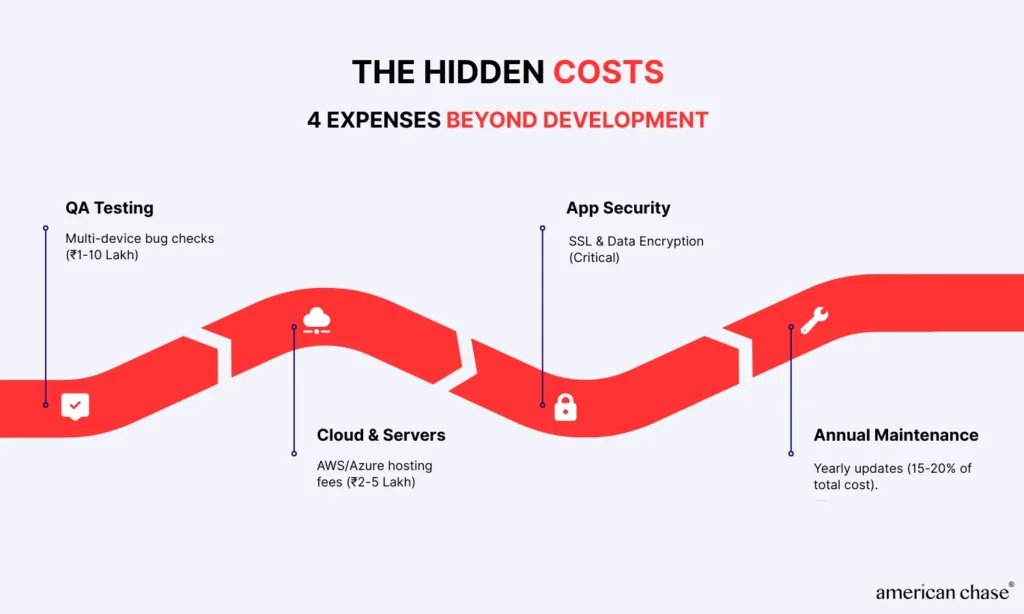
The Hidden Costs Nobody Warns You About

Here’s where budgets go sideways. These aren’t optional extras – they’re essentials that rookies forget to include.
Testing and QA: Because Bugs Kill Apps
Testing runs ₹1-10 lakh depending on how thoroughly you want to test functionality across different devices. Skip this, and you’re basically launching a grenade.
What comprehensive testing covers:
- Functionality across all features
- Multiple devices and screen sizes
- Different OS versions
- Network conditions (including spotty 3G)
- Load testing for traffic spikes
- Security vulnerability scanning
The cost of skipping QA: One star reviews, angry users, and rebuilding features that should’ve worked from day one. Testing isn’t expensive – fixing preventable disasters is.
Security and Compliance: The Non-Negotiables
Apps need robust security measures to protect user data and sensitive information. This isn’t paranoia – it’s survival.
Security must-haves:
- Data encryption (at rest and in transit)
- Secure authentication
- API security
- Regular security audits
- GDPR/data protection compliance
For fintech or healthcare apps? Add 20-30% to your budget for compliance alone. Fintech apps need advanced security layers and compliance with PCI-DSS and GDPR, pushing costs to $30,000-$150,000.
Maintenance: The Forever Cost
Here’s the truth bomb: launching your app isn’t the finish line – it’s the starting gun.
Annual maintenance runs ₹1-20 lakh depending on update scope and marketing efforts. Budget 15-20% of your initial development cost annually.
What maintenance actually includes:
- Bug fixes (they’re inevitable)
- OS compatibility updates (iOS and Android update regularly)
- Security patches
- Feature enhancements
- Server and hosting costs
- App store fees and renewals
Pro tip: Factor in maintenance from day one. Apps that aren’t maintained become digital ghosts within 6-12 months.
Smart Strategies to Maximize Your Budget
Want to build a great app without draining your bank account? Here’s how the pros do it.
Start with MVP: Build Smart, Not Big
Don’t try to build everything at once. Startups should budget ₹4-12 lakh for a complete cross-platform MVP. Get core features out, validate with real users, then iterate.
MVP mindset shift:
- Focus on solving ONE problem exceptionally well
- Launch fast, learn faster
- Use real user data to guide feature development
- Save budget for improvements that actually matter
Real example: Airbnb’s first version was embarrassingly basic – just a way to list and book rooms. They didn’t build messaging, reviews, payments, or recommendations until users proved they wanted them. That’s MVP done right.
Thinking about validating your idea? Check out the complete guide to MVP development to understand what features make the cut.
Choose Your Pricing Model Wisely
Fixed-price models offer predictable budgets when scope is clear, while hourly billing provides flexibility for evolving requirements.
Fixed-price: When to use it
- Your requirements are crystal clear
- You want budget certainty
- Timeline is flexible
Hourly billing: When it makes sense
- Requirements will evolve (they usually do)
- You want maximum flexibility
- You’re building something truly innovative
Dedicated team: The hybrid approach
- Monthly rates for continuous access to developers
- Scales up or down based on needs
- Perfect for long-term projects with ongoing development
My take: Start fixed-price for your MVP to control costs. Once you’re live and iterating, switch to a dedicated team model for continuous improvement.
Cross-Platform: Your Cost-Cutting Secret Weapon
React Native cuts costs to ₹6-18 lakh since one codebase works for both iOS and Android. Modern cross-platform frameworks have evolved dramatically – they’re not the janky compromise they used to be.
Why cross-platform wins in 2026:
- Near-native performance
- Faster development cycles
- One team maintains everything
- Code reusability means faster feature development
When it’s the right move:
- You need iOS and Android presence
- Your app doesn’t require cutting-edge device features
- You want to iterate quickly based on user feedback
Partner with the Right Team: It’s Not Just About Cost
Here’s an uncomfortable truth: 71% of app projects fail because of poor communication between clients and developers. The cheapest option is expensive if it fails.
What separates great development partners:
- Portfolio with apps similar to yours (not just pretty screenshots)
- Clear, regular communication processes
- Transparent project management
- Real client testimonials you can verify
- Post-launch support that’s actually responsive
Red flags to watch for:
- Rock-bottom pricing (quality costs something)
- Vague timelines or deliverables
- No clear project management methodology
- Can’t explain their development process
- Disappear after the contract is signed
Want the complete playbook? Read our guide on choosing the right mobile app development company.
Industry-Specific Cost Reality Check
Different industries play by different rules. Here’s what to expect.
FinTech: Where Security Isn’t Optional
Fintech apps need advanced security, real-time sync, multi-factor authentication, and PCI-DSS/GDPR compliance, running $30,000-$150,000.
Why fintech costs more:
- Regulatory compliance isn’t negotiable
- Security requirements are extreme
- Real-time transaction processing
- Integration with banking systems
- Rigorous testing and auditing
Budget breakdown for fintech:
- Base app: 40% of budget
- Security and compliance: 30%
- Integration and testing: 20%
- Ongoing compliance: 10%
Healthcare: Complexity Meets Regulation
Healthcare apps cost $35,000-$250,000 depending on features like telemedicine, HIPAA compliance, and real-time patient monitoring.
Healthcare cost drivers:
- HIPAA/medical data compliance
- Integration with medical devices
- Electronic health records (EHR) systems
- Telemedicine infrastructure
- Patient data security
E-Commerce and Delivery: Scale Is the Challenge
Grocery delivery apps with inventory management, real-time tracking, and route optimization run $20,000-$200,000.
What pushes e-commerce costs:
- Real-time inventory management
- Multiple payment gateways
- Order tracking and notifications
- Vendor management systems
- Complex logistics algorithms
Why India’s App Development Scene Is Leveling Up
India isn’t just competing globally anymore – it’s leading. Here’s why 2026 is different.
The numbers tell the story. Indian users downloaded over 28 billion apps in 2023, making India one of the top markets globally. When developers are building for a market this massive, they get really good at understanding what users actually want.
The 5G revolution is real. With 700 million 5G subscriptions expected by 2028, according to Ericsson, Indian developers aren’t just keeping up with global trends – they’re setting them. AR shopping experiences, real-time multiplayer gaming, instant video consultations – these aren’t future features, they’re being built right now.
AI integration that actually makes sense. Indian developers are moving beyond buzzword AI to practical implementations – recommendation engines that learn user preferences, chatbots that don’t suck, and predictive analytics that businesses can actually use.
Government backing creates momentum. The Digital India initiative isn’t just talk. From startup incubators to simplified business regulations, there’s serious infrastructure supporting tech innovation.
Want to understand where this is all heading? Check out our deep dive on the future of mobile app development in India.
Cost Comparison: India vs. The World
Let’s put the numbers in perspective with what you’d pay elsewhere.
| App Complexity | India | USA | UK | Australia |
| Simple MVP | ₹5-15L ($6-18K) | $50-80K | £40-65K | $50-100K |
| Mid-Range Business App | ₹15-40L ($18-48K) | $80-200K | £60-150K | $80-180K |
| Complex Enterprise | ₹40-80L ($48-95K) | $200-500K+ | £150-400K+ | $180-450K+ |
Hourly rate comparison:
| Region | Junior Dev | Mid-Level | Senior Dev |
| India | $18-20 | $30-40 | $50-60 |
| Eastern Europe | $30-45 | $50-70 | $80-100 |
| Western Europe | $60-80 | $90-120 | $140-180 |
| USA | $80-120 | $120-180 | $200-300 |
The bottom line: You’re looking at 60-70% cost savings in India without compromising on quality. That’s not marketing spin – that’s basic math.
Making Your App Investment Count
Building a successful app isn’t just about managing costs – it’s about maximizing return on every rupee spent.
Start with crystal-clear requirements. Vague requirements lead to scope creep, which leads to budget overruns. Document your vision, identify your core users, and define must-have features before you talk to any developers.
Think beyond launch day. Your app isn’t a one-time project – it’s an ongoing product. Budget for iteration, growth, and evolution. The first version is just the beginning.
Prioritize scalability. Building an app that handles 100 users is easy. Building one that scales to 100,000 without breaking requires smart architecture from day one. Cutting corners here costs exponentially more later.
Launch smart with the right strategy. Building a great app is half the battle – getting users to download and actually use it is the other half. Need help with that? Our mobile app launch strategy guide breaks down exactly how to turn launches into success stories.
Conclusion
So there you have it – the complete, no-BS breakdown of mobile app development cost in India for 2026.
Whether you’re planning a lean MVP for ₹5 lakh or a feature-packed enterprise solution pushing ₹80 lakh, India offers something unique: world-class development talent at prices that make sense for businesses of any size.
The key takeaways:
- Simple apps start at ₹5-15 lakh, perfect for MVPs and market testing
- Most business apps land in the ₹15-40 lakh sweet spot
- Complex enterprise solutions require ₹40-80 lakh but deliver serious capabilities
- Your biggest cost drivers: complexity, platform choice, team structure, and ongoing maintenance
- Smart strategies like MVP-first approach and cross-platform development can cut costs 30-50%
But here’s what matters most: the cheapest option isn’t always the best investment, and the most expensive isn’t always necessary. Success comes from finding the right balance between your vision, your budget, and your timeline – then partnering with a team that actually gets it.
Ready to turn your app idea into reality without the guesswork? Let’s talk about your project. At American Chase, we’ve helped businesses across industries build apps that users love and investors fund – all while keeping budgets realistic and timelines achievable.
Your app doesn’t have to be a financial gamble. With the right strategy and the right team, it can be your best business decision yet.
Build High-Performance Mobile Apps That Drive Real Business Results
Transform your idea into a fast, scalable, user-first mobile app with a development team focused on ROI, performance, and future-ready architecture.
Explore Mobile App DevelopmentFAQs
1. What’s the real average cost of mobile app development in India in 2026?
Most business apps with solid functionality cost between ₹15-40 lakh ($18,000-$48,000). Simple MVPs start around ₹5 lakh, while complex enterprise apps can reach ₹80 lakh or more. It’s not about finding an “average” – it’s about understanding what your specific app needs and budgeting accordingly.
2. How long does it actually take to build a mobile app in India?
Simple apps take 1-3 months from concept to app store. Mid-complexity business apps need 4-9 months. Complex enterprise solutions require 10-18 months depending on features and how often requirements change (they always do). Add another 2-4 weeks for app store review and launch prep. If anyone promises a full-featured app in 4 weeks, run.
3. Should I build for iOS first, Android first, or both at once?
Depends on your users and budget. iOS users spend more money but Android has bigger market share in India. Going cross-platform with React Native or Flutter costs 30-50% less than building both natively and gets you on both platforms simultaneously. For most businesses, cross-platform is the smart play – unless you need specific native features or your analytics show your users are heavily concentrated on one platform.
4. What’s better – hiring freelancers or working with an agency?
Freelancers work if you’re comfortable managing the project yourself, need specific features added to an existing app, or have a really tight budget. Agencies make sense for business-critical apps where you need reliability, accountability, and a full team (design, development, QA, project management). My advice? Use agencies for your core app, freelancers for smaller updates once you’re live. Trying to save 30% upfront by going with a freelancer on your main app isn’t worth it if the project fails or drags on for months.
5. What hidden costs will wreck my budget if I don’t plan for them?
The big ones: QA testing (₹1-10 lakh), which you absolutely cannot skip; security and compliance, especially for fintech or healthcare (add 20-30%); and ongoing maintenance (budget 15-20% of initial cost annually). Also factor in app store fees, hosting costs, and the inevitable “oh, we need to change this” moments that pop up during development. Build a 15-20% contingency buffer into your budget. You’ll use it.
6. Can I really build a quality app for ₹5 lakh, or is that just clickbait?
Yes, but it’s an MVP – not a fully-loaded product. For ₹5 lakh, you get a simple app with core features that proves your concept works. Think basic login, a few key screens, and one main function done well. Instagram started with a photo filter and sharing – that’s it. Build your MVP, get real users, gather data, then invest more based on what actually matters to them. Anyone who tells you they’ll build the next Uber for ₹5 lakh is either lying or doesn’t understand what Uber actually does.
7. What’s the single biggest mistake that blows up app budgets?
Scope creep disguised as “one more feature.” You start with a clear plan for 10 features, then during development you think of 5 more “must-haves,” which need 3 more to work properly, and suddenly you’re 6 months behind schedule and 80% over budget. Every feature sounds essential at the moment. Discipline separates successful launches from development hell. Define your MVP features, lock them down, build them, launch them, then iterate based on real user feedback – not what you think users want.